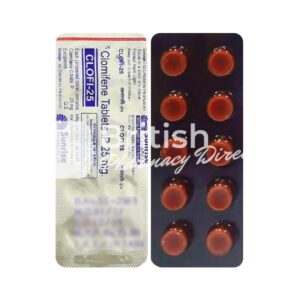
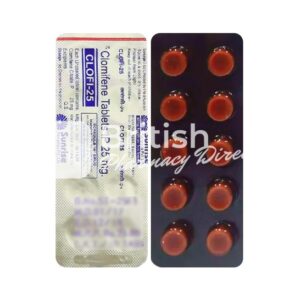
Clomiphene
In brief
- Clomiphene is a prescription-only medicine in the UK and many other countries, used under medical supervision for fertility treatment. If you are buying it online, only use a legitimate pharmacy and check local rules, as prescription requirements may vary by country.
- Clomiphene is used mainly to induce ovulation in women with anovulatory infertility, including some cases of PCOS, and is sometimes used off-label in men for infertility. It works as a selective oestrogen receptor modulator (SERM), blocking oestrogen feedback at the hypothalamus and pituitary to increase FSH and LH release and stimulate ovulation.
- The usual dose for female infertility is 50 mg once daily for 5 days, usually starting on day 3 to 5 of the menstrual cycle; the dose may be increased in later cycles up to 150 mg per day if needed. For male off-label use, 25–50 mg daily may be used for 3 to 6 months.
- Clomiphene is taken by mouth as tablets.
- It usually starts to act within the first treatment cycle, with ovulation often occurring about 5 to 10 days after the last tablet in women.
- The effect lasts for one treatment cycle at a time, and courses may be repeated for up to 6 ovulatory cycles. In men, treatment is commonly continued for 3 to 6 months.
- Alcohol should be avoided or kept to a minimum, as it may worsen side effects such as dizziness, flushing, or nausea and is not advisable when trying to conceive.
- The most common side effects are hot flushes, headache, dizziness, nausea, abdominal discomfort, mood changes, breast tenderness, and visual disturbances.
- Would you like to try clomiphene without a prescription?
Critical Warnings, Restrictions And Patient Protection In The UK
Clomifene can be very helpful in the right patient, but it is not a medicine to start casually or buy from an unregulated website.
In the UK, clomifene is an MHRA-licensed prescription-only medicine, so safe supply should always follow proper medical assessment and prescription checks.
- Do not take if you are pregnant, have a known hypersensitivity to clomifene or any excipient, have liver disease or impairment, have ovarian cysts not due to PCOS, have unexplained uterine bleeding, or have organic intracranial lesions or tumours.
- Higher-risk groups include people with PCOS, enlarged ovaries, thyroid or adrenal dysfunction, endometriosis, fibroids, or any significant chronic illness that may affect fertility treatment safety.
- Work and driving caution is important if you develop dizziness, fatigue, or visual disturbance, especially if you do safety-critical work, drive for a living, or operate machinery.
If you are asking “is this suitable for me?”, the safest answer is only after a clinician has reviewed your cycle history, hormone profile, and any past pelvic or liver problems.
That matters because the risks are not the same for every patient, and ovulation stimulants need monitoring for response and side effects.
Clomifene tablets should never be bought from unregulated sites that do not verify prescription status and UK pharmacy registration.
Buying from informal sellers can mean the wrong strength, poor storage, or medicine that is simply not what it claims to be.
If the treatment is being used properly, patients should know when to stop and seek advice quickly.
- Stop and seek help if you get severe abdominal pain, breathlessness, heavy bleeding, fainting, or sudden visual symptoms such as blurring, flashes, or spots.
- Also report promptly any rapidly worsening bloating, marked pelvic discomfort, or symptoms that suggest ovarian enlargement.
Can I Take Clomifene If I Might Already Be Pregnant?
No.
Pregnancy is an absolute contraindication, so non-pregnant status should be confirmed before treatment starts.
Basic Clomiphene Information
- INN (International Nonproprietary Name): Clomifene, alternatively spelled Clomiphene.
- Brand names available in United Kingdom: Clomid.
- ATC Code: G03GB02.
- Forms & dosages: Oral tablets only, commonly 25mg, 50mg, and 100mg; packaging is usually strips, blisters, or cartons of 10, 30, or 50 tablets.
- Manufacturers in United Kingdom: Merck Serono, Sanofi-Aventis, Teva, Cipla, Sun Pharma, Organon, and EGIS are listed among major suppliers globally.
- Registration status in United Kingdom: Licensed by the MHRA.
- OTC / Rx classification: Prescription-only (Rx) worldwide.
What Clomifene Is: Names, Classification And UK Availability
Clomifene is the international nonproprietary name, and you may also see it written as clomiphene in articles, clinic letters, or product information.
For many UK patients, the best-known brand is Clomid, which is why searches such as Clomid UK
The medicine sits in ATC group G03GB02, which places it among synthetic ovulation stimulants and helps with pharmacovigilance tracking.
In practical terms, it is supplied as oral tablets rather than an injection or liquid.
Common pack sizes include 10, 30, or 50 tablets, with 25mg, 50mg, and sometimes 100mg strengths depending on the market.
Outside the UK, related brand names include Serophene, Omifin, Clostilbegyt, Clomiphène®, Réprefol, and Fertomid, but UK patients are most likely to encounter Clomid tablets through regulated prescription routes.
- INN
- Clomifene, also spelled Clomiphene.
- Brand
- Clomid in the UK context.
- ATC
- G03GB02, a synthetic ovulation stimulant.
- Dosage forms
- Oral tablets in 25mg, 50mg, and 100mg strengths.
How Clomifene Works In The Body
Many patients want the simple version first: clomifene helps the body release hormones that can trigger ovulation.
It works as a selective oestrogen receptor modulator, or SERM, which means it blocks oestrogen feedback at the hypothalamus and pituitary in a way that encourages gonadotropin release.
That hormonal signal can help stimulate ovulation in people who are not ovulating regularly.
The marketed medicine contains a racemic mix of two stereoisomers, enclomiphene and zuclomiphene.
Only the racemic mixture is marketed.
This is why response can vary from patient to patient, and why monitoring matters rather than assuming the same result for everyone.
| What It Does | What Patients May Notice |
|---|---|
| Encourages pituitary hormone release and ovulation | Periods may become more predictably ovulatory, with timed monitoring in clinic |
| Alters oestrogen signalling in target tissues | Hot flushes, mood changes, or headaches can happen |
| Used mainly for ovulation induction | It may be prescribed when a fertility work-up suggests anovulation |
For some men, specialists may use clomifene off-label for infertility, but that is a separate pathway and should be specialist-led.
Who Clomifene Is Used For In NHS And Private Care
In UK practice, clomifene is mainly used for female infertility linked to anovulation.
That includes patients where the ovaries are not releasing an egg regularly, and it may be considered in some people with PCOS when suitable and monitored.
Before anyone is prescribed Clomid for ovulation, an NHS or private clinician will usually want a fertility work-up first.
That generally means hormone evaluation, menstrual history, and checking that contraindications are not present.
- Suitable candidates include adults with anovulatory infertility after assessment, and selected patients with PCOS-related ovulatory dysfunction.
- Not suitable until assessed includes children and young people under 16, routine elderly fertility care, or anyone with unresolved bleeding, liver problems, or suspected pregnancy.
- Off-label use may include male infertility, but that should be managed by a specialist.
For male infertility, the usual specialist-led dose is 25mg to 50mg daily for 3 to 6 months, with sperm analysis checks.
That kind of plan is not for self-treatment, and it should not be started without medical review.
Standard Dosing And Cycle Timing For UK Patients
The question most patients ask is simple: when do I start, and how long do I take it for?
For female infertility due to anovulation, the standard starting regimen is 50mg daily for 5 days.
This is usually started on cycle day 3 to 5, depending on the clinician’s instructions.
If ovulation does not occur, the dose may be increased in selected cases, up to 150mg per day under specialist supervision.
Courses may be repeated for up to 6 ovulatory cycles, but do not self-adjust or keep taking it indefinitely.
| Indication | Usual Dose | Duration | Monitoring |
|---|---|---|---|
| Female infertility due to anovulation | 50mg daily for 5 days | Up to 6 ovulatory cycles | Ovulation tracking and review of side effects |
| Male infertility, off-label | 25mg to 50mg daily | 3 to 6 months | Sperm analysis and specialist review |
If you miss a dose, take it the same day if you remember.
If a day is already missed, skip it and do not double the next dose.
What If I Miss A Dose?
Take it on the same day if you remember.
Otherwise skip it and continue as prescribed.
Do not double dose.
Contraindications, Cautions And Monitoring Before Starting
Before clomifene is prescribed, the key issue is not just whether it may work, but whether it is safe for the person sitting in front of the clinician.
There are clear reasons not to use it at all, and other situations where specialist monitoring is needed.
| Do Not Use | Use Only With Specialist Monitoring |
|---|---|
| Pregnancy, known hypersensitivity, liver disease or impairment, ovarian cysts not due to PCOS, unexplained uterine bleeding, organic intracranial lesions or tumours | PCOS, enlarged ovaries, thyroid or adrenal dysfunction, endometriosis, history of uterine fibroids, significant chronic illness |
Baseline assessment should usually include pregnancy exclusion, menstrual history, and review of any liver or endocrine issues.
PCOS is not a simple yes-or-no issue either, because it can increase the risk of ovarian enlargement or hyperstimulation, so it needs proper oversight.
Patients should also mention any visual disorders, unexplained bleeding, or previous ovarian cysts before treatment starts.
Side Effects And When To Get Help Urgently
Most side effects are mild to moderate, but it is still important to know what to expect and what should never be ignored.
Common problems include hot flushes, headache, dizziness, fatigue, mood changes, nausea, abdominal discomfort, breast tenderness, rash, blurred vision, photophobia, and visual spots.
Reproductive effects can include ovarian enlargement and, occasionally, multiple gestation.
- Common side effects: hot flushes, headache, dizziness, fatigue, mood changes, nausea, abdominal discomfort, breast tenderness, rash, blurred vision, photophobia, visual spots.
- Fertility-related risks: ovarian enlargement and multiple gestation.
If anything feels severe or sudden, do not wait for the next appointment.
- Get urgent review if you develop sudden vision changes.
- Get urgent review if you have severe abdominal pain.
- Get urgent review if you are breathless, faint, or collapse.
- Get urgent review if you have heavy bleeding.
As with MHRA-style safety vigilance, new visual symptoms should be taken seriously and reported promptly through normal NHS routes or pharmacist advice.
Interactions With Alcohol, Food, Medicines And Activities
Most patients want to know whether they can take clomifene with breakfast, a glass of wine, or alongside other tablets.
It can usually be taken with or without food, and taking it after food may help if nausea is a problem.
Alcohol should be kept moderate, as it may make dizziness or nausea worse.
A full medicines review is important before prescribing, particularly if the patient already takes treatment for endocrine, fertility, or chronic medical conditions.
| Interaction | Possible Effect | What To Do |
|---|---|---|
| Food | Usually no major effect | Take with food if nausea occurs |
| Alcohol | May worsen dizziness or nausea | Keep intake moderate or avoid if symptomatic |
| Other medicines | Potential interaction risk depends on the full regimen | Tell the prescriber about every medicine and supplement |
| Driving and machinery | Unsafe if visual symptoms, fatigue, or dizziness occur | Do not drive or use machinery if affected |
Can I Drive After Taking It In The UK?
Only if you feel well and have no visual disturbance, dizziness, or fatigue.
If symptoms occur, do not drive.
Clomifene And Fertility Treatment Pathways In The UK
Clomifene usually sits early in a fertility pathway rather than as a stand-alone answer.
In NHS care, patients often start with assessment, lifestyle advice, ovulation tracking, and correction of obvious contributing factors before a prescription is considered.
For PCOS, metformin may also be part of the picture, depending on the clinical plan.
If clomifene is unsuitable or does not work, treatment usually moves on to alternatives rather than continuing forever.
That is why repeat review matters after each cycle.
- Assessment: confirm cause of infertility, check hormones, and exclude contraindications.
- Prescription: start clomifene at the usual cycle dose if appropriate.
- Monitoring: track ovulation, side effects, and ovarian response.
- Review: limit repeated cycles and assess whether treatment is working.
- Alternative therapy: move to other fertility options if there is non-response or intolerance.
That approach protects patients from months of ineffective treatment and reduces the chance of avoidable complications.
Clinical Evidence And Real-World Outcomes
Clomifene has been used for a long time as an ovulation stimulant, which is part of why it remains familiar to fertility clinics and pharmacists.
At the same time, newer options such as letrozole are often discussed, especially for certain fertility pathways.
Effectiveness depends heavily on the cause of infertility, age, BMI, and the underlying hormonal picture.
No fertility medicine should be sold as a guaranteed route to pregnancy.
| Finding | Clinical Meaning | Patient Relevance |
|---|---|---|
| Long regulatory history and ATC coding | Supports structured pharmacovigilance and familiar clinical use | Reassuring, but not a substitute for review |
| Response varies by infertility cause | Different patients need different pathways | Not everyone will ovulate or conceive on the same schedule |
| Monitoring remains important | Helps detect ovarian enlargement and visual adverse effects | Follow-up should not be skipped |
Alternatives To Clomifene: Comparison For UK Patients
If clomifene is not suitable, or if repeated cycles do not produce the desired response, there are other routes to discuss with a fertility specialist.
Letrozole is commonly mentioned as an alternative for ovulation induction, while gonadotropins are injectable options used under close supervision.
Some patients may be offered tamoxifen, metformin, or assisted conception pathways such as IVF protocols depending on the cause of infertility.
| Option | How It Works | Advantages | Limitations | UK Use |
|---|---|---|---|---|
| Letrozole | Aromatase inhibitor used for ovulation induction | Common alternative in fertility care | Not suitable for everyone | Used in specialist fertility pathways |
| Gonadotropins | Injectable FSH/hMG stimulation | Effective in selected cases | Costlier and needs close supervision | Specialist use only |
| Tamoxifen | Another SERM with limited fertility use | May suit some patients | Less common for fertility | Occasional specialist use |
| Metformin | Used in PCOS-associated ovulation induction | May help in combination plans | Not a direct ovulation stimulant on its own | Often part of PCOS management |
| Natural cycle / IVF protocols | Assisted conception or no-stimulation approaches | Useful for non-responders or contraindications | More involved and more expensive | Specialist fertility care |
- Pros: oral dosing, familiar prescribing pathway, long clinical experience.
- Cons: not suitable in pregnancy, liver disease, or unexplained bleeding, and monitoring is still needed.
UK Access: NHS Prescription, Private Clinics And Online Pharmacies
In the UK, clomifene can be supplied through NHS prescribing, private clinics, or regulated pharmacies that dispense against a valid prescription.
GPs, fertility clinics, and specialist prescribers may all be involved depending on the pathway and the local service.
High-street pharmacy names such as Boots, LloydsPharmacy, and Superdrug are familiar routes for many patients, while electronic prescriptions have made private and online fulfilment easier.
If you are searching for terms like Clomid 50mg buy online
In our online pharmacy, clomifene is available without a prescription, with discreet delivery to United Kingdom in 5-14 days.
| Access Route | How It Works | Advantages | Limitations |
|---|---|---|---|
| NHS prescription | Issued by GP, fertility clinic, or specialist | Structured care and monitoring | May involve waiting times |
| Private clinic | Specialist assessment and private prescription | Faster access to review | Private consultation fees apply |
| High-street pharmacy | Dispenses against prescription | Convenient local collection | Depends on stock and script |
| Online pharmacy | Prescription fulfilment and home delivery | Discreet and convenient | Must be UK-registered and regulated |
NHS Cost And Regional Prescription Differences
The cost of clomifene in the UK depends on where you live and whether you are using NHS or private treatment.
In England, NHS prescription charges usually apply unless you are exempt.
In Scotland, Wales, and Northern Ireland, NHS prescriptions are generally free.
Private pricing varies by pharmacy, pack size, and whether the medicine is generic or brand supplied.
Clomifene is always prescription-only, so price should never be the only consideration.
| Source / Pharmacy | Typical Price Range | Prescription Charge | Exemption Status |
|---|---|---|---|
| NHS in England | Standard NHS charge applies | Yes, unless exempt | Exemptions may apply |
| NHS in Scotland | Generally free | No | Generally exempt |
| NHS in Wales | Generally free | No | Generally exempt |
| NHS in Northern Ireland | Generally free | No | Generally exempt |
| Private pharmacy | Varies by pharmacy and pack size | No NHS charge | Not applicable |
| Region | Prescription Rule | Typical Patient Cost Pattern |
|---|---|---|
| England | NHS charges usually apply unless exempt | May pay standard prescription fee |
| Scotland | NHS prescriptions are generally free | No routine prescription charge |
| Wales | NHS prescriptions are generally free | No routine prescription charge |
| Northern Ireland | NHS prescriptions are generally free | No routine prescription charge |
Storage, Transport And Household Handling In The UK
Storage is straightforward, but a few household habits can prevent avoidable damage to the tablets.
Clomifene should be kept at room temperature, between 15 and 30°C, and protected from moisture and light.
Do not refrigerate or freeze it.
Keep it in the original packaging until use, especially if it is being moved between home, work, and clinic appointments.
- Do store in a dry cupboard away from heat.
- Do keep the carton and blister intact.
- Do carry it in hand luggage when travelling.
- Do not leave it in the bathroom, on a damp windowsill, or in a hot car.
- Do not refrigerate or freeze the tablets.
How Pharmacists And Clinicians Advise Safe Use
Good counselling should feel practical rather than overwhelming.
A UK pharmacist or clinician will usually confirm the indication, explain cycle timing, check missed-dose rules, warn about visual symptoms, and agree a follow-up plan.
Patients should also be encouraged to mention fertility goals, previous treatment cycles, side effects, and any conditions such as thyroid disease, liver issues, endometriosis, or fibroids.
If the medicine is repeated, the review should not be skipped just because the tablets are familiar.
That is especially important if cycles are not working as expected or if new symptoms appear.
- Patient guidance checklist: confirm why you are taking it, know when to start, know what symptoms are urgent, and know when the next review is due.
- Consultation-style checks: pregnancy status, liver history, bleeding history, ovarian cyst history, visual symptoms, and all current medicines.
- Follow-up plan: ovulation tracking, response review, and stopping rules if adverse effects or non-response occur.
If a patient is worried, local pharmacist advice and normal NHS routes remain the right first step.
Do I Need Monitoring While Taking Clomifene?
Yes.
Monitoring helps reduce risks such as ovarian enlargement, multiple pregnancy, and missed contraindications.
Delivery Across United Kingdom
| City | Region | Delivery time |
|---|---|---|
| London | England | 5-7 days |
| Birmingham | England | 5-7 days |
| Manchester | England | 5-7 days |
| Leeds | England | 5-7 days |
| Liverpool | England | 5-7 days |
| Edinburgh | Scotland | 5-7 days |
| Glasgow | Scotland | 5-7 days |
| Cardiff | Wales | 5-7 days |
| Belfast | Northern Ireland | 5-7 days |
| Sheffield | England | 5-9 days |
| Newcastle upon Tyne | England | 5-9 days |
| Nottingham | England | 5-9 days |
| Southampton | England | 5-9 days |
| Aberdeen | Scotland | 5-9 days |
| Swansea | Wales | 5-9 days |