Rybelsus
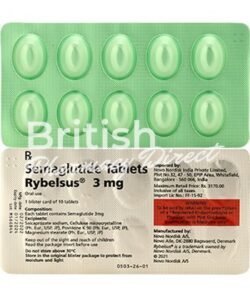
In stock
3mg · 7mg · 14mg
from 160,54 £
In brief
- Rybelsus is semaglutide in tablet form, a GLP-1 medicine taken once a day by adults with type 2 diabetes.
- Three strengths (3, 7 and 14 mg); quantities start at 10 tablets and go up to 90.
- POM in the UK; the 3/7/14 mg tablets are the earlier UK formulation, since replaced there by 1.5, 4 and 9 mg.
Rybelsus, the oral form of semaglutide
Rybelsus contains semaglutide, which mimics GLP-1, a hormone released by the gut after eating. When blood glucose is high it prompts the pancreas to release more insulin and less glucagon, and it slows the emptying of the stomach. Most GLP-1 receptor agonists are injections; this one is formulated with salcaprozate sodium, an absorption enhancer that lets a small share of the semaglutide cross the stomach lining. According to the UK SmPC, it is for adults whose type 2 diabetes is not well enough controlled, alongside diet and exercise: either as the single diabetes medicine where metformin cannot be taken, or in combination with other treatments for blood glucose, which may include insulin. It has no place in type 1 diabetes or in the emergency treatment of ketoacidosis.
Old and new UK strengths explained
Rybelsus is stocked here at 3 mg, 7 mg and 14 mg, every strength in quantities of 10, 20, 30, 60 or 90, sourced as an imported product. On the electronic medicines compendium, that 3/7/14 mg series is the first UK version of the tablet and carries a discontinued label. The current British tablets are 1.5 mg, 4 mg and 9 mg, a reformulation in which 1.5 mg corresponds to 3 mg, 4 mg to 7 mg and 9 mg to 14 mg. The figures look different but the doses match, so anyone switching between the two series should confirm the equivalent strength with their prescriber or pharmacist rather than comparing milligrams.
From 3 mg to the maintenance dose
Treatment opens with 3 mg once daily for a month, a run-in period that helps the gut get used to the medicine. The maintenance dose is then 7 mg, and if blood glucose still needs bringing down after at least a further month on 7 mg, the dose can move up to 14 mg, which is the highest. A single tablet covers the whole day, and making up a higher dose from two lower-strength tablets has not been studied and is not recommended. If a day is missed, that dose is left out and the usual tablet is taken the next morning. Older age and reduced kidney function do not call for a different dose. People already taking a sulfonylurea or insulin may have that dose lowered to avoid hypoglycaemia.
Empty stomach, a little water, then a wait
Only a tiny fraction of each tablet reaches the bloodstream, and food, drinks or other tablets taken too close to it cut that further. The SmPC therefore asks for the tablet to be swallowed whole on an empty stomach with no more than half a glass of water (up to 120 ml), then a gap of at least 30 minutes before eating, drinking or taking other oral medicines. Pop the tablet out of its blister only when it is due, as the pack protects it from light and moisture. Levothyroxine levels can rise, so thyroid tests may be repeated, and warfarin users should have their INR checked more often at the start.
Cautions before and during treatment
Allergy to semaglutide or any ingredient is the only formal contraindication, but several warnings apply. Severe, lasting stomach pain could mean pancreatitis and should be checked promptly. People with diabetic eye disease on insulin need eye checks, as a rapid fall in glucose can temporarily make retinopathy worse. There is little experience in NYHA class IV heart failure, severe gastroparesis or after weight-loss surgery. Fluid loss from vomiting or diarrhoea can affect the kidneys, and the anaesthetist should know about treatment before any procedure. Effective contraception is advised, Rybelsus should be stopped at least two months before a planned pregnancy because semaglutide lingers in the body, and it is not used while breastfeeding.
What users of Rybelsus may experience
Nausea and diarrhoea affect more than one user in ten, as does low blood sugar when insulin or a sulfonylurea is also taken. Vomiting, stomach pain or bloating, constipation, indigestion, wind, loss of appetite, tiredness, headache and dizziness are common. Less often (uncommon) there may be gallstones, belching, an altered sense of taste or a raised pulse; anaphylaxis and pancreatitis fall into the rare group. Whether this medicine fits a person’s diabetes plan, and at which strength, is for the prescriber to judge.