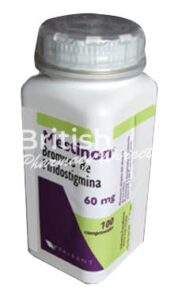
Mestinon
In stock
60mg
from 61,15 £
In brief
- Mestinon contains pyridostigmine bromide, which helps nerve signals reach the muscles and is prescribed mainly for myasthenia gravis.
- An imported product: 60 mg tablets in packs of 30, 60, 90, 120, 180 or 240.
- A prescription-only medicine in the UK, with doses spread through the day to suit the individual.
What Mestinon does for tired, weak muscles
Mestinon is a cholinesterase inhibitor whose active ingredient is pyridostigmine bromide. Muscles contract when a nerve releases acetylcholine, and an enzyme called cholinesterase then breaks that messenger down within moments. In myasthenia gravis the body’s own antibodies reduce the number of working receptors, so the signal fades too quickly and muscles tire with use, often showing as heavy eyelids, double vision, a weak voice or trouble swallowing by evening. By holding back the enzyme, pyridostigmine lets acetylcholine linger and act more strongly. According to the UK SmPC, the tablets are also used for paralytic ileus and for urinary retention following an operation. A dose generally starts to work within half an hour to an hour, and its effect is gentler and longer-lasting than that of neostigmine, with fewer bowel symptoms.
Tablet strength and quantities offered
This listing has a single strength of 60 mg pyridostigmine bromide per tablet, sold in quantities of 30, 60, 90, 120, 180 or 240 tablets. It is an imported product, so the packaging and the enclosed leaflet will not match the UK-licensed pack. The UK tablet is cross-scored for splitting; if a smaller dose has been prescribed, look closely at whether these tablets carry a score line before attempting to break one.
Fitting doses to the demands of the day
Doses in myasthenia gravis are tailored rather than fixed. The SmPC suggests 30 to 120 mg at a time for adults, with each dose timed to cover the moments when muscle power is needed most, for instance getting up in the morning, eating a main meal or going out. Each daytime dose tends to last three to four hours; a bedtime dose may hold for around six hours. Most adults end up taking somewhere between five and twenty tablets over a day, and higher totals are reserved for close supervision. For children, treatment begins at 30 mg under six years of age and at 60 mg from six to twelve, with daily increases of 15 to 30 mg until the response is satisfactory. When the bowel has stalled or the bladder will not empty after surgery, the usual adult range is 60 to 240 mg spread across the day. The kidneys clear most of the drug, so lower doses may suit people with kidney impairment. Swallow each tablet with water.
UK status of pyridostigmine
Under UK rules pyridostigmine is classed as POM, so a prescriber has to authorise each supply. Two 60 mg products are licensed here, the Mestinon brand and a generic pyridostigmine bromide tablet, and the official documents for both can be found on the electronic medicines compendium (emc). This imported product is not covered by either licence.
Who should avoid it, and medicines that interact
An allergy to pyridostigmine or any bromide rules Mestinon out, and so does a physical obstruction in the intestine or the urinary passages. Extra care is needed with asthma or COPD, because airway narrowing and more mucus are possible. Your doctor will also want to know about bradycardia, a heart attack in the recent past, hypotension, peptic ulcer disease, epilepsy, parkinsonism, thyrotoxicosis or impaired kidneys. Lactose is listed among the excipients of the British version. Corticosteroids, immunosuppressants and removal of the thymus may all reduce how much pyridostigmine is needed, although a steroid can make weakness worse for a short spell when first started. Methylcellulose may block absorption, while atropine and hyoscine oppose its action. Muscle relaxants given during anaesthesia may behave unpredictably, and aminoglycoside antibiotics, certain anaesthetics and some antiarrhythmic drugs can worsen myasthenic symptoms.
Cholinergic side effects and overdose
The unwanted effects follow from having more acetylcholine about. The gut may respond with queasiness, being sick, loose motions or colicky pain; you may also notice a wet mouth, a chest full of phlegm, sweating, constricted pupils and hazy vision, a slower heartbeat, or flickering and cramping muscles. Should a rash appear, any medicine containing bromide has to be withdrawn. Taking too much can lead to a cholinergic crisis, where weakness deepens and can be mistaken for a flare of the myasthenia itself; worsening weakness, breathing difficulty or widespread twitching need urgent care via 999 or A&E. If your vision blurs, stay off the road until it is sharp again. The schedule for Mestinon is set by the doctor treating your myasthenia.