
Stalevo
In brief
- In our pharmacy, you can buy Stalevo without a prescription, with delivery in 9–21 days throughout the United Kingdom. Discreet and anonymous packaging.
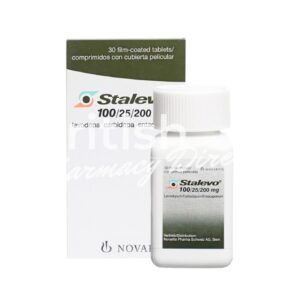
- Stalevo is used to treat Parkinson’s disease in adults experiencing motor fluctuations (“wearing off”); it combines levodopa (a dopamine precursor), carbidopa (a peripheral dopa decarboxylase inhibitor) and entacapone (a COMT inhibitor) to increase central dopamine levels and prolong the effect of levodopa.
- The usual dose is matched to the patient’s current levodopa/DDCI regimen; commonly one tablet per dose taken 3–7 times daily depending on symptoms and tablet strength, titrated as needed; do not exceed 200 mg levodopa per dose or approximately 2,000 mg per day.
- Form of administration: oral film‑coated tablets (available in strengths from 50/12.5/200 mg up to 200/50/200 mg, all containing 200 mg entacapone).
- Onset time: effects typically begin within 20–60 minutes after an oral dose.
- Duration of action: an individual dose commonly lasts around 3–6 hours; entacapone generally prolongs “on” time and reduces wearing‑off between doses.
- Alcohol warning: avoid excessive alcohol as it can worsen dizziness, orthostatic hypotension, sedation and other adverse effects.
- The most common side effect is nausea.
- Would you like to try Stalevo without a prescription?
Basic Stalevo information
- INN (international nonproprietary name): Levodopa, carbidopa, entacapone.
- Brand names available in the United Kingdom: Stalevo (film-coated tablets), prescription only; supplied in brown, oval film-coated tablets in multiple strengths.
- ATC code: N04BA03.
- Forms and dosages: Stalevo film-coated tablets containing 200 mg entacapone in all strengths.
- Manufacturers in the United Kingdom: Novartis and Orion Pharma.
- Registration status in the United Kingdom: Licensed by the MHRA for prescription use.
- OTC / Rx classification: Prescription-only medicine (POM), not available over the counter.
Critical warnings and restrictions
High‑risk groups (elderly, pregnancy, chronic illness)
Stalevo is a prescription-only medicine and must be prescribed and reviewed by a clinician.
Inform the prescriber about any cardiac disease, psychosis, severe hepatic disease, renal impairment, pregnancy or breastfeeding.
- Absolute contraindications: known hypersensitivity to any component, narrow‑angle glaucoma, severe liver disease and phaeochromocytoma.
- Elderly: start at a lower dose and review frequently for orthostatic hypotension, sedation and dyskinesia.
- Pregnancy/breastfeeding: avoid unless benefit clearly outweighs risk and seek specialist neurology/obstetric advice.
- Monitoring actions: baseline lying and standing blood pressure.
- Monitoring actions: liver function tests where hepatic concerns exist.
- Monitoring actions: renal monitoring for severe impairment.
- Monitoring actions: mental health review for psychosis or suicidality.
- Monitoring actions: review concomitant medicines for interactions.
Checklist for patient pre-clinic review:
- List current levodopa/DDCI and other Parkinson’s medicines.
- Record any history of heart disease, psychiatric illness or liver disease.
- Note episodes of fainting, falls or sudden sleepiness.
- Bring a current medicines list and recent blood tests, if available.
Interaction with activities (driving, workplace safety under UK law)
Counsel patients about dizziness, somnolence, sudden sleep onset and impaired attention while taking Stalevo.
Driving: follow DVLA guidance and inform the DVLA if medication affects ability to drive.
Employers should perform a risk assessment for safety‑critical roles such as machine operation or working at height.
Pharmacists should document counselling and consider Yellow Card reports where reactions affect fitness to drive.
Immediate actions if symptoms occur:
- Stop driving or operating machinery immediately.
- Contact the prescriber, specialist nurse or pharmacist for urgent review.
- Record episodes of sudden sleepiness or blackouts and report to the clinician.
- Consider temporary work adjustments for safety‑critical duties.
Q&A — “Can I drive after taking it in the UK?”
Q: Can I drive after taking Stalevo?
A: Not if you experience dizziness, excessive sleepiness, sudden sleep episodes or impaired alertness.
A: UK driving law requires you to inform the DVLA if a medication adversely affects driving ability.
A: Stop driving and contact your prescriber or pharmacist for review and report serious reactions to the MHRA Yellow Card scheme.
Usage basics
INN, brand names available in the UK
INN: levodopa, carbidopa, entacapone — the fixed triple combination marketed as Stalevo.
All Stalevo tablets contain 200 mg entacapone per film‑coated tablet.
- Stalevo 50: 12.5 mg carbidopa + 50 mg levodopa + 200 mg entacapone.
- Stalevo 75: 18.75 mg carbidopa + 75 mg levodopa + 200 mg entacapone.
- Stalevo 100: 25 mg carbidopa + 100 mg levodopa + 200 mg entacapone.
- Stalevo 125: 31.25 mg carbidopa + 125 mg levodopa + 200 mg entacapone.
- Stalevo 150: 37.5 mg carbidopa + 150 mg levodopa + 200 mg entacapone.
- Stalevo 200: 50 mg carbidopa + 200 mg levodopa + 200 mg entacapone.
- Brand/generic equivalents: Stalevo is the primary brand supplied by Novartis/Orion in the UK.
- Brand/generic equivalents: alternative levodopa/DDCI products exist but do not include entacapone.
Legal classification (POM, P, GSL)
Stalevo is a prescription-only medicine in the UK and is not available over the counter.
- Prescription routes: NHS paper prescriptions.
- Prescription routes: NHS electronic prescriptions through the NHS e‑Prescription Service.
- Prescription routes: private prescriptions issued by UK clinicians.
Dosing guide
Standard regimens (NHS guidelines)
Indication: for adults with Parkinson’s disease and motor fluctuations despite levodopa/DDCI therapy.
Initiate Stalevo by matching the patient’s current levodopa/DDCI dose to the closest Stalevo tablet strength and adjust for symptom control.
Typical dosing is one tablet per dose three to seven times daily, tailored to the patient’s on/off pattern.
Maximum: do not exceed 200 mg levodopa per dose or 2,000 mg levodopa per day as per the product summary.
| Current co‑careldopa + entacapone regimen | Example Stalevo conversion |
|---|---|
| Co‑careldopa 100 mg + entacapone per dose | Stalevo 100 (25/100/200) once or twice daily as clinically required |
| Co‑careldopa 125 mg + entacapone per dose | Stalevo 125 (31.25/125/200) to match levodopa exposure |
| Co‑careldopa 200 mg + entacapone per dose | Stalevo 200 (50/200/200), respecting levodopa maxima |
- Common dosing frequencies: three times daily for baseline control.
- Common dosing frequencies: up to seven times daily for patients with frequent wearing off.
- Common dosing frequencies: tailor timing to individual motor fluctuation patterns.
Adjustments for comorbidities
Reduce the starting dose in elderly or medically frail patients and monitor closely.
Renal impairment: use with caution and monitor for increased adverse effects.
Hepatic impairment: avoid or reduce dose because entacapone exposure increases.
Children: not indicated.
Coordinate with cardiology or psychiatry when there is a history of arrhythmia, psychosis or severe cardiovascular disease.
Checklist for dose-adjustment triggers and monitoring schedule:
- Trigger: new or worsening orthostatic hypotension — check lying and standing BP within days of initiation.
- Trigger: hepatic impairment — check liver function tests before and during treatment.
- Trigger: renal decline — review renal function and adverse events periodically.
- Monitoring schedule: review within 1–2 weeks of initiation or dose change, then periodically as clinically indicated.
Q&A — “What if I miss a dose?”
Q: Missed dose guidance?
A: Take the missed dose as soon as you remember unless the next dose is due soon.
A: Do not double the next dose to make up for a missed one.
A: If in doubt contact your GP, specialist nurse or pharmacist for individualised advice.
A: Persistent missed doses or fluctuating control may require regimen review.
Interaction chart
Food and drinks (alcohol, tea/coffee, diet habits)
Dietary protein can reduce levodopa absorption and blunt clinical effect.
Advise a consistent protein intake and, where possible, space high‑protein meals away from key doses to improve on‑time.
Alcohol may worsen dizziness and orthostatic hypotension and should be taken in moderation.
Caffeine can affect sleep and may increase insomnia when combined with Stalevo.
Take Stalevo with or after food if nausea occurs, but monitor symptom control for reduced absorption.
- Tip: keep protein intake consistent across the day rather than large protein loads at dose times.
- Tip: if nausea limits dosing, try taking with a light carbohydrate snack and review with prescriber if control worsens.
| Meal timing | Advice |
|---|---|
| High‑protein meal at dose time | May reduce levodopa absorption; consider shifting protein to later in the meal. |
| Light snack with dose | Can reduce nausea with minimal impact on absorption for most patients. |
Common drug conflicts
Major interactions include non‑selective MAO inhibitors, dopamine antagonists and certain adrenergic drugs.
Dopamine antagonists such as metoclopramide can reduce the efficacy of levodopa formulations.
Antipsychotics may worsen motor control and require specialist review before starting Stalevo.
Entacapone can influence hepatic exposure and may interact with other hepatically cleared drugs.
Pharmacists should report suspected adverse drug reactions via the Yellow Card scheme.
| Drug class | Risk | Action |
|---|---|---|
| Non‑selective MAO inhibitors | Hypertensive crises | Avoid combination; stop MAOI before starting Stalevo. |
| Dopamine antagonists (e.g., metoclopramide) | Reduced levodopa effect | Replace with alternative antiemetic where possible. |
| Antipsychotics | Worsening motor symptoms | Coordinate with psychiatry; consider dose adjustments. |
- Medicines reconciliation: check all prescribed, OTC and herbal medicines at each dispensing.
- Medicines reconciliation: record and flag any interactions for prescriber review.
Legal status and availability in the UK
In our online pharmacy, Stalevo is available without a prescription, with discreet delivery to the United Kingdom in 9–21 days.
Mechanism and pharmacology
Simplified explanation
Stalevo combines levodopa, the dopamine precursor, with carbidopa and entacapone in a single tablet.
Carbidopa (a DDCI) limits peripheral conversion of levodopa to dopamine and increases the amount reaching the brain.
Entacapone (a COMT inhibitor) blocks peripheral COMT to prolong levodopa plasma half‑life and smooth plasma fluctuations.
The triple combination increases ON time by reducing peripheral metabolism of levodopa.
Clinical terms
ATC code: N04BA03 (levodopa combinations).
All tablets include a fixed 200 mg entacapone dose per tablet and varying levodopa/carbidopa amounts.
Pharmacokinetic note: dosing must respect levodopa maxima of 200 mg per dose and 2,000 mg/day total levodopa.
- COMT inhibitor: a medicine that blocks catechol‑O‑methyltransferase to slow levodopa breakdown.
- DDCI (dopa decarboxylase inhibitor): carbidopa, reduces peripheral levodopa conversion and peripheral side effects.
- ON/OFF: ON time denotes periods of good motor control; OFF time denotes return of Parkinsonian symptoms.
Indications and off‑label uses
MHRA‑approved uses
- Approved indication: adults with Parkinson’s disease experiencing motor fluctuations (‘wearing off’) despite levodopa/DDCI therapy.
- Age limits: not indicated for patients under 18 years.
- Prescription rationale: match Stalevo dose to the patient’s current levodopa exposure for convenience and symptom control.
Off‑label practices in NHS and private care
Off‑label use of Stalevo is uncommon in routine practice.
Clinicians may tailor regimens with split dosing or alternative combinations to fit individual motor patterns.
Any off‑label decision should be documented with informed consent and specialist oversight.
- Checklist for documentation and consent: state off‑label rationale in the medical record and obtain patient consent.
- Checklist for documentation and consent: arrange specialist neurology follow‑up and record monitoring plans.
Alternatives matrix
NHS prescribing alternatives (comparison table)
| Product | Components | Pros | Cons | Typical UK availability |
|---|---|---|---|---|
| Sinemet | Levodopa/carbidopa | No fixed entacapone; dosing flexibility | No COMT inhibition; may require separate entacapone | Widely available on NHS |
| Madopar | Levodopa/benserazide | Alternative DDCI pairing for some patients | No entacapone included | Available on NHS |
| Comtan | Entacapone (add‑on) | Flexible dosing with separate levodopa | Increases pill burden | Available as add‑on therapy |
Pros and cons checklist
- Pros: single‑tablet convenience that may improve adherence and provide consistent entacapone dosing.
- Cons: less flexibility for independent levodopa and entacapone titration due to fixed 200 mg entacapone per tablet.
- Cons: potential for increased dyskinesia because of prolonged levodopa exposure.
- Use for shared decision‑making: weigh adherence benefits against need for flexible titration.
Common questions
Will Stalevo stop my tremor?
Stalevo improves bradykinesia, rigidity and OFF episodes, but tremor response is variable.
Will urine discolouration mean my kidneys are damaged?
Urine discolouration is usually benign and related to entacapone metabolites, but report urinary symptoms to your clinician.
Can this cause hallucinations?
Yes, hallucinations can occur, especially in older patients or those with prior psychosis; report these immediately to the prescriber.
- Contact points: Parkinson’s nurse, GP or pharmacist for symptom‑specific advice.
- Report ADRs to MHRA Yellow Card: encourage patients to report new serious adverse effects.
Useful links:
Registration and regulation
MHRA approval process
Stalevo is authorised by the MHRA for prescription use.
Manufacturers include Novartis and Orion Pharma.
Report any safety signals to the MHRA Yellow Card scheme and follow UK pharmacovigilance guidance.
NHS prescribing framework
Prescribing should align with local NHS formularies and NICE guidance on Parkinson’s disease management.
Document indication, prior levodopa dose, dosing frequency and monitoring plan when prescribing Stalevo.
- Consider shared care agreements between specialist neurology and primary care for long‑term prescribing.
- Record any dose changes and arrange timely follow‑up after initiation.
Storage and handling
UK household storage (cold/damp climate)
Store Stalevo below 30°C and protect from moisture and light.
Keep tablets in the original blister pack until use.
In UK homes prone to humidity, advise storing in a dry, elevated place away from bathrooms.
Keep out of reach of children and pets and avoid transferring tablets to loose containers that allow moisture ingress.
When travelling, carry tablets in original packaging with a prescription or clinic letter.
- Home storage tip: a bedroom cupboard away from radiators and windows is usually suitable.
- Travel tip: use the original blister for protection and temperature buffering during transit.
- Pharmacist counselling script: explain storage, disposal and what to do if a tablet becomes damp.
Guidance from NHS and pharmacists
Provide a written dosing schedule or medicines card showing tablet strength and timing.
Advise safe disposal of unused tablets via pharmacy returned medicines schemes.
Note courier temperature exposure and use tracked, temperature‑protected delivery for vulnerable patients where necessary.
| Do’s | Don’ts |
|---|---|
| Keep in original blister pack below 30°C. | Do not store in bathroom or near sinks. |
| Carry prescription documentation when travelling. | Do not transfer to pill organisers for long storage in damp environments. |
Guidelines for proper use
UK pharmacist counselling style
Adopt a patient‑centred approach when counselling on Stalevo.
Confirm the indication and the patient’s prior levodopa dose before switching or initiating Stalevo.
Explain the triple mechanism: levodopa/carbidopa/entacapone and how this affects on/off control.
Review common side effects including nausea, dyskinesia, urine discolouration, orthostatic hypotension and insomnia.
Advise on missed dose management, overdose actions and when to seek urgent care for severe dyskinesia, confusion or arrhythmia.
Document counselling and offer follow‑up via repeat dispensing or a medicines review.
- Checklist template: indication, current meds, dose plan, side effects to expect, driving/work safety advice, follow‑up date.
- Patient leaflet outline: what Stalevo contains, how to take, storage, side effects and contact details for urgent advice.
NHS patient safety advice
Arrange follow‑up within 1–2 weeks of initiation and after any dose changes.
Involve the Parkinson’s nurse where available for practical titration support.
Record Yellow Card reports for new serious adverse drug reactions.
- Follow‑up timing: 1–2 weeks after start, then at clinician discretion.
- Monitoring parameters: BP (lying/standing), liver function where indicated, mental health review.
- Escalation criteria: severe dyskinesia, new psychosis, syncope or significant arrhythmia.
Delivery across the United Kingdom
| City | Region | Delivery Time |
|---|---|---|
| London | England | 9–21 days |
| Birmingham | England | 9–21 days |
| Manchester | England | 9–21 days |
| Glasgow | Scotland | 9–21 days |
| Edinburgh | Scotland | 9–21 days |
| Leeds | England | 9–21 days |
| Bristol | England | 9–21 days |
| Cardiff | Wales | 9–21 days |
| Belfast | Northern Ireland | 9–21 days |
| Newcastle | England | 9–21 days |
| Southampton | England | 9–21 days |
| Plymouth | England | 9–21 days |
| Norwich | England | 9–21 days |
| Stirling | Scotland | 9–21 days |