Fludrocortisone
In stock
100 mcg
from 45,86 £
In brief
- Fludrocortisone is a synthetic steroid that does the job of aldosterone, keeping sodium and fluid in the body when the adrenal glands cannot.
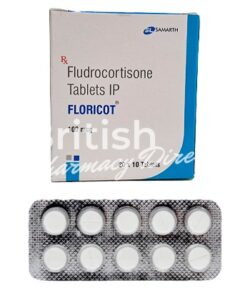
- Each tablet contains 100 micrograms, also expressed as 0.1 mg, with 30 to 360 tablets per box.
- An imported product; in the UK, fludrocortisone is a prescription-only medicine (POM).
Fludrocortisone in adrenal hormone replacement
Fludrocortisone acetate is a corticosteroid with a strong mineralocorticoid effect. Aldosterone, normally made by the adrenal cortex, tells the kidneys to retain salt and water and to excrete potassium; fludrocortisone copies that signal. Under the UK SmPC it has two licensed uses: Addison’s disease, where it partly replaces missing adrenal hormones, and the salt-losing type of congenital adrenal hyperplasia (adrenogenital syndrome). Its sodium-retaining power is so pronounced that it is not advised for other conditions. In Addison’s disease it is normally combined with a glucocorticoid, and the SmPC notes that cortisone or hydrocortisone by mouth should be added when a stronger glucocorticoid effect is required.
What the listing covers
Every tablet listed contains 100 micrograms, the same as 0.1 mg. Smaller quantities of 30, 60 or 90 tablets sit alongside larger packs of 120, 180, 270 and 360. The tablets on this page are imported. British patients receive 0.1 mg fludrocortisone acetate tablets made under several UK licences, each of them a POM.
Setting the daily dose
For adults the SmPC gives a range of 0.05 to 0.3 mg a day, which corresponds to half a tablet up to three tablets of 100 micrograms; where 0.05 mg is needed, a product suited to that dose is recommended. For a child, half to one tablet a day is typical, tailored to body weight, age and how severe the condition is. No particular dose is set for older people, though they need the same careful monitoring. Because the medicine is so potent, salt intake and dose are watched together to prevent high blood pressure, fluid retention and weight gain, and blood electrolytes are checked from time to time during long-term use. Regular follow-up allows the dose to be fine-tuned, and the lowest dose that controls the condition keeps unwanted effects down.
Steroid card, illness and stopping
People on long-term Fludrocortisone should carry a steroid treatment card recording the medicine, dose and prescriber. Prolonged corticosteroid use can cause the adrenal glands to shrink, and this may last for years, so treatment must never be stopped abruptly; instead, the dose is lowered step by step over weeks or months. During serious illness, injury or surgery, extra steroid cover may be needed both while on treatment and for up to a year after it ends. Steroids also dampen the immune response: chickenpox, shingles and measles can be dangerous, so contact with anyone who has them should be reported to a doctor promptly, and live vaccines must not be given. A body-wide infection rules the tablets out unless it is already being treated with an appropriate antibiotic, antifungal or antiviral.
Medicines that change its effect
Potassium can fall further when Fludrocortisone is combined with diuretics that deplete potassium or with amphotericin, and low potassium raises the risk of toxicity with digitalis glycosides such as digoxin. Enzyme-inducing medicines like rifampicin, phenytoin and carbamazepine may weaken its effect, while ketoconazole and CYP3A inhibitors, including cobicistat-boosted treatments, can increase it. Oestrogens, including those in hormonal contraceptives, can raise steroid levels, so the dose may need trimming. Antidiabetic medicines and anticoagulants may need their doses adjusting, and taking NSAIDs alongside raises the chance of stomach bleeding; ciclosporin is a further interaction to declare.
Side effects to know about
Most unwanted effects stem from the salt-retaining action: low blood potassium, raised blood pressure, fluid retention with swelling, and in some cases heart failure or an enlarged heart. Headache and muscle weakness are common. Steroids can also affect the mind; hallucinations and distorted perception are listed as uncommon, and any change in mood or behaviour should be reported quickly. Any blurring of sight should lead to an eye examination: corticosteroids are linked with cataract, glaucoma and a rare retinal condition, central serous chorioretinopathy. Seek urgent help for swelling of the face or throat. The decision to start or adjust Fludrocortisone rests with your doctor or prescriber.