Midodrine
In brief
- In our pharmacy, you can buy midodrine without a prescription, with delivery in 9–21 days throughout the United Kingdom. Discreet and anonymous packaging.
- Midodrine is used to treat symptomatic orthostatic hypotension; it is a prodrug converted to desglymidodrine, an alpha-1 adrenergic agonist that causes peripheral vasoconstriction and raises blood pressure.
- The usual dose is 2.5–10 mg three times daily (typically start at 2.5 mg three times daily and titrate); the common maximum is 10 mg three times daily.
- The form of administration is an oral tablet.
- The effect of the medication begins within about 30 minutes (peak effect around 1 hour).
- The duration of action is approximately 2–4 hours per dose (hence dosing three times daily in most regimens).
- Do not consume alcohol — alcohol may worsen dizziness and counteract or complicate blood-pressure effects.
- The most common side effects are piloerection (goosebumps), tingling/paraesthesia and the risk of supine hypertension.
- Would you like to try midodrine without a prescription?
Basic midodrine information
- INN (international nonproprietary name): Midodrine (midodrine hydrochloride)
- Brand names available in the United Kingdom: Bramox; generic midodrine
- ATC code: C01CA17
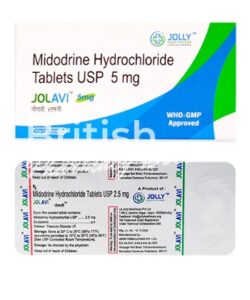
- Forms and dosages: Tablets 2.5 mg and 5 mg
- Manufacturers in the United Kingdom: Midodrine tablets are supplied by several manufacturers
- Registration status in the United Kingdom: Licensed by the MHRA; prescription only
- OTC / Rx classification: Prescription-only medicine (POM)
Critical warnings, immediate safety and patient protection (UK focus)
Midodrine is a centrally important symptomatic treatment for orthostatic hypotension but carries significant safety risks that demand early screening and clear documentation.
Priorities for patient safety in the United Kingdom are clear: record supine blood pressure before starting therapy and exclude uncontrolled supine hypertension.
Assess for bladder outflow obstruction, severe cardiac disease and phaeochromocytoma before initiation.
Use extreme caution with older people and the frail because of increased falls risk.
Exercise caution in patients with chronic renal impairment and arrange monitoring of renal function.
Pregnancy and breastfeeding data are limited, so seek specialist advice before use in these groups.
- Contraindications and high‑risk flags:
- Uncontrolled supine hypertension.
- Known phaeochromocytoma.
- Severe cardiac disease (e.g., recent myocardial infarction, unstable angina).
- Significant bladder outflow obstruction or urinary retention.
- Known hypersensitivity to midodrine.
- Pre‑treatment baseline tests — checklist:
- Supine and standing blood pressure (document both and the exact times taken).
- ECG if clinically indicated (cardiac history or symptoms).
- Renal function: baseline eGFR/creatinine.
- Medication review for interacting drugs and agents that affect autonomic tone.
- Document urinary symptoms and perform appropriate urological review if indicated.
Q&A — “Can I drive after taking it in the UK?”
Do not drive if midodrine causes dizziness, syncope or impaired alertness.
Report such symptoms to your GP or specialist without delay and stop driving until assessed.
Check DVLA guidance and discuss driving fitness with your prescriber during titration and at each review.
Usage basics — names and legal status
INN, UK brand names and legal classification
INN: midodrine (midodrine hydrochloride) is the active name used in clinical practice for orthostatic hypotension.
UK brand examples include Bramox and other licensed or generic midodrine tablets in strengths of 2.5 mg and 5 mg.
Legally in the United Kingdom midodrine is prescription‑only (POM) and should be initiated on specialist recommendation or according to a local formulary.
- Midodrine
- INN: midodrine (midodrine hydrochloride); Prescription-only medicine for symptomatic orthostatic hypotension; tablet strengths 2.5 mg and 5 mg.
Dosing guide (NHS‑relevant regimens and titration)
Standard regimens and titration
Typical adult starting dose is 2.5 mg orally three times daily: morning, midday and late afternoon.
Titrate cautiously at intervals of 2–3 days and use standing blood pressure and symptomatic response to guide increments.
Many protocols allow titration to a typical maximum of 10 mg three times daily while monitoring for supine hypertension and adverse effects.
Avoid dosing within 4–5 hours of bedtime to reduce the risk of supine hypertension.
- Stepwise titration:
- Start 2.5 mg three times daily and record standing/supine BP for 2–3 days.
- If symptoms persist and standing BP remains low, increase to 5 mg three times daily and repeat monitoring.
- Consider further increments up to 10 mg three times daily only under specialist supervision and with supine BP checks after each change.
- If troublesome supine hypertension develops, reduce dose or discontinue and seek specialist review.
- Baseline and follow‑up observations — checklist:
- Supine BP after 5 minutes rest and standing BP at 1 and 3 minutes post‑standing.
- Repeat supine and standing BP within 24–72 hours of any dose increase.
- Keep an orthostatic symptom diary noting time of dose and symptoms (dizziness, light‑headedness, near‑syncope, syncope).
- Review urine symptoms and renal function in patients with CKD.
Q&A — “What if I miss a dose?”
If you remember a missed dose and it is not close to the time of your next dose, take it as soon as possible.
If it is near the next dose, skip the missed dose and take the next dose at the usual time.
Do not double doses to make up for missed ones and seek advice if several doses are missed or if symptoms return or worsen.
Interaction chart — drugs, food and MHRA‑relevant safety reporting
Food and drink, lifestyle interactions
Alcohol can worsen orthostatic symptoms and may interact with midodrine’s pressor effects, so counsel patients to avoid excessive alcohol.
Hot baths, saunas and rapid changes from sitting to standing increase the risk of symptomatic hypotension and should be approached with caution.
Caffeine can transiently affect blood pressure and orthostatic symptoms, so advise patients to monitor effects when changing intake.
Drug interactions
| Drug class | Likely effect | Action |
|---|---|---|
| Other sympathomimetics / vasopressors | May exacerbate hypertension, including supine rises | Avoid concomitant use or review with specialist if necessary |
| Antihypertensives | May blunt orthostatic benefit; unpredictable effects on supine BP | Coordinate doses and monitor BP closely; consider timing adjustments |
| Tricyclic antidepressants / MAO inhibitors | May alter autonomic control and exaggerate pressor response or orthostatic symptoms | Specialist review before co‑prescribing; close monitoring |
| Drugs causing urinary retention | May increase risk of urinary retention with midodrine | Assess bladder function and consider alternatives |
- Lifestyle advice:
- Avoid excessive alcohol and sudden heat exposure (hot baths/saunas).
- Use slow, staged positional changes from lying to standing.
- Wear compression stockings and maintain hydration unless contraindicated.
Report suspected adverse reactions to the MHRA Yellow Card scheme and encourage patients to do the same.
Legal status and availability in the UK
In our online pharmacy, midodrine is available without a prescription, with discreet delivery to the United Kingdom in 9–21 days.
Mechanism of action and basic pharmacology
Simplified explanation for patients
Midodrine is a prodrug that is converted in the body to desglymidodrine.
The active metabolite is an alpha‑1 adrenergic agonist that increases vascular tone and peripheral resistance.
This rise in peripheral resistance improves standing blood pressure and reduces orthostatic symptoms.
Onset is usually within 30–60 minutes and the typical duration of action per dose is 3–4 hours, explaining the need for multiple daytime doses.
Clinical pharmacology terms (for clinicians)
The active metabolite produces peripheral vasoconstriction with minimal central alpha effects.
Pharmacokinetics are influenced by renal function so dosage adjustments and monitoring are necessary in renal impairment.
- Prodrug
- Midodrine → metabolised to desglymidodrine.
- Active metabolite
- Desglymidodrine exerts alpha‑1 adrenergic agonism at peripheral vessels.
- Physiological effect
- Increased systemic vascular resistance → improved standing BP.
| Time | Effect |
|---|---|
| 0–30 minutes | Conversion begins; early pressor effect may appear |
| 30–60 minutes | Onset of symptomatic benefit for many patients |
| 3–4 hours | Typical duration of action; consider re‑dosing if clinically indicated |
Indications and off‑label uses in NHS practice
MHRA‑approved and common indications
Primary licensed indication is symptomatic orthostatic hypotension where non‑pharmacological measures are insufficient.
In specialist centres midodrine is used for neurogenic orthostatic hypotension such as autonomic failure in multiple system atrophy or Parkinson’s disease with autonomic involvement.
Off‑label and research uses
Occasional off‑label use occurs for refractory hypotension in carefully selected settings after specialist review.
Always check local trust formularies and document informed consent where use is off‑label.
- Indications vs contraindications:
- Indication: symptomatic orthostatic hypotension not controlled by conservative measures.
- Contraindication: uncontrolled supine hypertension, phaeochromocytoma, severe cardiac disease.
- Checklist for off‑label prescribing documentation:
- Rationale for off‑label use and expected benefits.
- Risks, monitoring plan and informed consent recorded in notes.
- Local pharmacy and trust formulary approval if required.
Alternatives matrix — NHS prescribing choices and pros/cons
Comparison table of alternatives
| Drug / measure | Mechanism | Typical effect | Main risks |
|---|---|---|---|
| Midodrine | Alpha‑1 agonist (prodrug) | Rapid symptomatic improvement in standing BP | Supine hypertension, urinary retention, multiple daytime dosing |
| Fludrocortisone | Mineralocorticoid — increases volume | Improves orthostatic BP by expanding intravascular volume | Oedema, hypokalaemia, hypertension |
| Compression garments / salt and fluids | Non‑pharmacological support | Reduces venous pooling; adjunctive benefit | Acceptability and adherence; limited effect alone |
Pros and cons checklist
- Pros of midodrine:
- Rapid symptomatic benefit for many patients.
- Particularly useful for neurogenic causes of orthostatic hypotension.
- Cons of midodrine:
- Risk of supine hypertension.
- Short duration requiring multiple daytime doses.
- Possible urinary retention in susceptible individuals.
Common patient questions
- What are the most likely side effects?
Most likely effects include supine hypertension, piloerection, scalp tingling, urinary urgency or retention and paraesthesia.
- How will I be monitored?
Baseline and post‑titration supine and standing blood pressure measurements are required, with renal function reviewed if indicated.
- Can midodrine be combined with compression stockings or fludrocortisone?
Often yes, under specialist supervision with coordinated monitoring of blood pressure and electrolytes.
Registration, regulation and prescribing framework (MHRA and NHS)
MHRA approval and formulary position
Check the MHRA product licence status and local trust formulary before initiation.
Many trusts list midodrine as specialist‑initiated with shared‑care agreements for GP continuation.
Prescribing framework and documentation
Document the indication, baseline BP readings, a clear titration plan and a supine BP monitoring schedule in the medication record.
Arrange for informed consent and explain the risks, particularly supine hypertension and urinary retention.
- Checklist for prescribers:
- Confirm licence and formulary code where applicable.
- Provide patient information leaflet and written titration plan.
- Advise on Yellow Card reporting and how to report adverse reactions.
Storage, handling and household guidance (UK climate considerations)
Domestic storage and transport
Store midodrine tablets at room temperature away from moisture, typically 15–25°C.
Avoid bathroom cabinets where humidity may degrade tablets.
Keep medication in the original packaging with child‑resistant blisters where provided.
When travelling carry a copy of the NHS/e‑prescription and keep medication in hand luggage.
Disposal and lost/expired medication
Return unused or expired medicines to any pharmacy for safe disposal; do not flush down the toilet.
If medication is lost contact the prescriber or pharmacist for interim advice rather than doubling doses.
| Storage item | Recommended range |
|---|---|
| Room temperature | 15–25°C |
| Avoid | High humidity/heat (e.g., bathrooms) |
- Home storage, travel and disposal checklist:
- Keep in original pack, away from children and pets.
- Carry prescription details when travelling abroad and check import rules.
- Return unused medicine to pharmacy for disposal.
Practical guidelines for proper use and pharmacist counselling
Counselling points for UK pharmacists
Advise patients to take midodrine during daytime only and to avoid supine posture within four hours of dosing.
Explain the risk of supine hypertension and the need for supine and standing blood pressure monitoring.
Tell patients to seek emergency help for severe headache, chest pain, visual disturbance or very high blood pressure readings.
Reinforce general safety: do not stand up quickly, use compression stockings, maintain hydration and report urinary retention promptly.
Safety checklist for discharge and repeat prescriptions
- Provide a written dosing and titration plan and the prescriber’s contact details.
- Give a BP diary and clear instructions when to measure supine and standing values.
- Explain Yellow Card reporting and encourage patients to report suspected side effects.
- Emergency signs
- Severe headache, chest pain, visual disturbance, marked hypertension — seek urgent assessment.
Delivery across the United Kingdom
| City | Region | Delivery Time |
|---|---|---|
| London | England | 9–21 days |
| Birmingham | England | 9–21 days |
| Manchester | England | 9–21 days |
| Glasgow | Scotland | 9–21 days |
| Leeds | England | 9–21 days |
| Liverpool | England | 9–21 days |
| Bristol | England | 9–21 days |
| Edinburgh | Scotland | 9–21 days |
| Sheffield | England | 9–21 days |
| Newcastle | England | 9–21 days |
| Leicester | England | 9–21 days |
| Coventry | England | 9–21 days |
| Nottingham | England | 9–21 days |
| Belfast | Northern Ireland | 9–21 days |
| Cardiff | Wales | 9–21 days |
Practical closing notes for clinicians and pharmacists
Midodrine can be a highly effective option for symptomatic orthostatic hypotension when used with careful baseline assessment and monitoring.
Ensure supine blood pressure is recorded prior to initiation and after dose changes, and document a clear plan for titration and stopping rules.
Coordinate care between hospital specialists and primary care, especially for frail older adults and those with renal impairment.
Encourage patients to report side effects via the MHRA Yellow Card and to seek urgent help for severe symptoms.