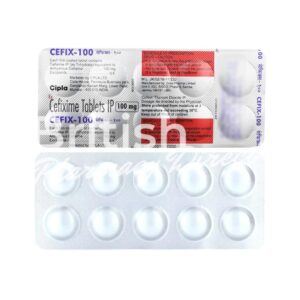
Cefixime
In brief
- In our pharmacy, you can buy cefixime without a prescription, with delivery in 9–21 days throughout the United Kingdom; discreet and anonymous packaging.
- Cefixime is an oral third‑generation cephalosporin antibiotic used to treat bacterial infections such as otitis media, pharyngitis, sinusitis, bronchitis, urinary tract infections and some cases of gonorrhoea; it inhibits bacterial cell‑wall synthesis by binding penicillin‑binding proteins, causing cell lysis.
- The usual adult dose is 400 mg once daily or 200 mg twice daily for 5–10 days depending on the infection (a single 400 mg dose may be used for uncomplicated gonorrhoea); paediatric dosing is typically around 8 mg/kg/day (maximum 400 mg/day) divided once or twice daily.
- The form of administration is oral — available as tablets and an oral suspension.
- Bactericidal activity begins within a few hours, with symptomatic improvement often noticeable within 24–48 hours.
- The plasma half‑life is about 3–4 hours, but clinical coverage from a dose commonly lasts 12–24 hours, which allows once‑daily dosing in many cases.
- There is no specific disulfiram‑like interaction with alcohol, but avoid excessive alcohol while unwell as it can worsen side effects and delay recovery.
- The most common side effect is diarrhoea; other frequent effects include nausea, abdominal pain and skin rash.
- Would you like to try cefixime without a prescription?
Basic cefixime information
- INN (international nonproprietary name): Cefixime
- Brand names available in the United Kingdom: Suprax; generic cefixime
- ATC code: J01DD08
- Forms and dosages: film-coated tablets 200 mg; oral suspension 100 mg/5 ml
- Manufacturers in the United Kingdom: generic manufacturers
- Registration status in the United Kingdom: Prescription-only medicine (POM)
- OTC / Rx classification: Prescription only (Rx)
Critical warnings, restrictions and patient protection
Immediate safety priorities for UK patients
Ask about any history of allergy to penicillins or cephalosporins before supply.
Check for any previous severe reactions such as anaphylaxis, Stevens–Johnson syndrome or angioedema.
Confirm current pregnancy or breastfeeding status before supply.
Assess for severe renal or hepatic impairment and recent Clostridioides difficile history.
Remember that cefixime is a prescription-only medicine (POM) in the UK and should only be supplied after clinician review.
Stop treatment and seek urgent care if signs of anaphylaxis, severe rash, sudden breathlessness, severe diarrhoea or jaundice develop.
Where to use: checklist for pharmacy counselling
- Confirm identity and prescription validity where applicable.
- Obtain allergy history focusing on penicillin and cephalosporin reactions.
- Check pregnancy and breastfeeding status.
- Review renal and hepatic disease history and current medicines.
- Advise on how to take the medicine and how to measure suspensions for children.
- Explain common side effects and when to stop and seek help.
Regulatory action
Report suspected adverse effects using the MHRA Yellow Card scheme.
MHRA Yellow Card is the route for clinicians and patients to report suspected side effects.
High‑risk groups
Frail elderly patients and those with renal impairment are at higher risk of adverse effects and require dose review.
Neonates and very young infants may have special dosing and safety considerations; consult neonatal guidance where relevant.
Use the lowest effective dose and review therapy promptly in patients with multiple comorbidities.
Q&A — “Can I drive after taking cefixime in the UK?”
Most people are unaffected after taking cefixime.
However, cefixime can rarely cause dizziness, vertigo or trigger an allergic reaction.
If you feel drowsy or dizzy, do not drive or operate machinery.
Usage basics (INN, brand names and legal classification)
INN, common UK brands and formulations
The International Nonproprietary Name is cefixime.
The UK brand is Suprax; generic cefixime is also available.
Typical formulations include 200 mg tablets and a paediatric oral suspension (100 mg/5 ml).
The table below maps each form to its usual strength.
| Form | Typical strengths |
|---|---|
| Film-coated tablets | 200 mg |
| Oral suspension (paediatric) | 100 mg/5 ml |
Legal classification and prescribing pathway in the UK
Cefixime is a Prescription‑Only Medicine (POM) in the UK and must be supplied against a valid prescription following clinician review.
NHS electronic prescriptions are acceptable where a prescriber has reviewed the patient for the acute indication.
Electronic repeat prescriptions are not appropriate for acute short courses without a clinical review.
- Prescription‑only medicine (POM)
- A medicine that must be prescribed by an authorised prescriber and supplied by a pharmacist on presentation of a valid prescription.
- Pharmacy (P)
- A medicine that can be sold from a registered pharmacy under pharmacist supervision without a prescription.
- General sales list (GSL)
- A medicine that can be sold in general retail outlets without pharmacist supervision.
Dosing guide (NHS-aligned, practical advice)
Standard regimens and stewardship
Typical adult dosing used in practice is 400 mg once daily or 200 mg twice daily for most indications.
Paediatric dosing is weight-based at approximately 8 mg/kg/day given once daily or divided, with a common maximum of 400 mg/day.
Always follow local microbiology or NHS guidance and consult the product SPC and BNF for licensed dosing for each indication.
Avoid prolonged or chronic use without clear microbiology support and regular review as part of antimicrobial stewardship.
Adjustments for comorbidities and renal impairment
Reduce dose or extend dosing interval in patients with significant renal impairment.
Consult the SPC or BNF for exact adjustment tables for different creatinine clearance bands.
Consider alternative agents if severe hepatic or renal failure is present and specialist advice is required.
Q&A — “What if I miss a dose?”
Take the missed dose as soon as you remember unless it is almost time for the next dose.
Do not double up doses to make up for a missed dose.
If you are unsure what to do after a missed dose, contact your GP or pharmacist for advice.
Checklist for dose administration:
- Write down dosing times for the patient to aid adherence.
- Give a measuring syringe for paediatric suspension and demonstrate use.
- Advise to complete the full prescribed course unless told otherwise by a prescriber.
Measuring the paediatric suspension:
- Use the supplied oral syringe or a medicine measure; kitchen spoons are inaccurate.
- Shake the bottle well before use and check the expiry after reconstitution.
- Discard any remaining suspension after the timeframe on the label (see storage section).
Interaction chart (medicines, food, alcohol)
Key drug–drug interactions and clinical relevance
| Interacting drug | Interaction type | Clinical action |
|---|---|---|
| Probenecid | Increases cefixime plasma levels by reducing renal excretion | Avoid concurrent use or monitor for increased adverse effects |
| Concurrent nephrotoxic agents (e.g., aminoglycosides, NSAIDs in susceptible patients) | Potential for increased renal risk with combined nephrotoxicity | Review renal function and avoid combination where possible |
| Oral contraceptives | Evidence of interaction is limited and debated | Advise barrier method if severe diarrhoea occurs or for prolonged courses |
| Other antibiotics (broad spectrum) | Alteration in gut flora; risk of secondary infections | Use stewardship principles; avoid unnecessary combinations |
Food, drink and alcohol
Cefixime tablets and suspension may be taken with or without food.
Advise patients to maintain adequate hydration while taking the antibiotic.
There is no specific contraindication to moderate alcohol consumption, but avoid heavy drinking while unwell.
Alcohol can compound gastrointestinal upset and dehydration.
High‑risk pairs and actions
- Probenecid: increases cefixime levels — avoid or monitor.
- Nephrotoxic drugs: review renal function before combining.
- Severe diarrhoea: may reduce oral contraceptive absorption — advise barrier contraception if concerned.
Legal status and availability in the UK
In our online pharmacy, cefixime is available without a prescription, with discreet delivery to the United Kingdom in 9–21 days.
Mechanism of action and pharmacology (simplified and clinical)
How cefixime works (plain language)
Cefixime is an oral third‑generation cephalosporin antibiotic.
It works by inhibiting bacterial cell wall synthesis through binding to penicillin‑binding proteins.
It is most active against many Gram‑negative organisms and some Gram‑positive bacteria.
Pharmacokinetics and elimination
Oral absorption is variable and can be affected modestly by food.
Oral bioavailability is moderate (general estimates are around 40–50%).
Cefixime achieves useful urinary concentrations for urinary tract infections and is excreted renally and partly in bile.
The elimination half‑life supports once‑daily dosing for many indications when renal function is normal.
| Parameter | Typical value / note |
|---|---|
| Absorption | Modest variability with food; can be taken with or without food |
| Bioavailability | Approximately 40–50% (general estimate) |
| Half‑life | Supports once‑daily dosing in many patients; check SPC for exact values |
| Excretion | Renal and biliary routes; renal impairment affects clearance |
Indications and off‑label uses (MHRA and NHS context)
Approved indications commonly prescribed in UK
Licensed uses commonly include treatment of uncomplicated urinary tract infections and some upper respiratory tract infections when caused by susceptible organisms.
Always check the SPC for licence specifics for each branded or generic product.
Off‑label and restricted uses (NHS/private practice)
Cefixime has historically been used for gonorrhoea, but rising resistance in Neisseria gonorrhoeae means ceftriaxone intramuscular therapy is preferred per UKHSA guidance.
Cefixime should not be used empirically for gonorrhoea unless local guidance supports susceptibility testing.
Pros / cons checklist for off‑label decisions
- Pro: Oral dosing may be convenient for outpatient therapy when susceptibility supports it.
- Con: Reduced efficacy for certain organisms with rising resistance.
- Pro: Useful alternative when first‑line agents are contraindicated and local susceptibility is favourable.
- Con: Off‑label use requires clear documentation and patient consent where appropriate.
- Off‑label
- Use of a licensed medicine for an indication, dose or population not specified in the SPC.
- Unlicensed
- Use of a medicine without a UK licence or a product reformulated locally; requires more formal governance.
Alternatives matrix (NHS prescribing alternatives)
Comparative table and selection checklist
| Agent | Common indications | Dosing convenience | Spectrum | Renal considerations |
|---|---|---|---|---|
| Amoxicillin | Respiratory infections, some ENT infections | Multiple daily dosing | Broad Gram‑positive and some Gram‑negative | Adjust in renal impairment |
| Cefalexin | Skin and soft tissue infections, UTIs | Multiple daily dosing | Oral first‑generation cephalosporin, Gram‑positive focus | Adjust in renal impairment |
| Nitrofurantoin | Uncomplicated lower UTIs | Multiple daily dosing; contraindicated in some renal impairments | Narrow, urinary‑tract focused | Not recommended if significant renal impairment |
| Co‑amoxiclav | Respiratory infections with suspected beta‑lactamase producers | Twice or three times daily | Broad spectrum including some beta‑lactamase producers | Adjust in renal impairment |
When to choose alternatives
- Prefer nitrofurantoin for uncomplicated lower urinary tract infection when local sensitivity supports use.
- Choose cefalexin for skin and soft tissue infections where a narrower spectrum is acceptable.
- Use local sensitivity data and stewardship principles when selecting antibiotics.
Common patient questions with short clinician responses
Can I take cefixime during pregnancy?
Use only if clinically needed after risk–benefit discussion with the prescriber.
Consider alternatives if national guidance suggests another agent for the indication.
Check the SPC and discuss with the prescriber before use.
Will it affect my contraceptive pill?
There is no strong evidence that a short course of cefixime reduces combined oral contraceptive efficacy.
If severe diarrhoea occurs or for prolonged antibiotic courses, advise use of barrier methods until the next cycle.
How long until I feel better?
Symptom improvement is often seen within 48–72 hours for many uncomplicated infections.
If symptoms worsen or fail to improve within this time, re‑assess with the prescriber.
Quick checklist for when to re‑contact the clinician:
- Persistent or worsening fever after 48–72 hours.
- New or spreading rash.
- Severe diarrhoea, particularly if bloody or with fever.
- Signs of jaundice or dark urine.
Registration, regulatory status and reporting
MHRA approval and SPC considerations
Cefixime is licensed in the UK with SPCs that vary by branded and generic products.
Prescribers and pharmacists should consult the SPC and the BNF for up‑to‑date dosing, cautions and renal adjustments.
Pharmacovigilance and Yellow Card reporting
Clinicians and patients should report suspected adverse drug reactions to the MHRA Yellow Card scheme.
Checklist for reporting:
- Report the suspected reaction and the suspected medicine.
- Include batch number and manufacturer if available.
- Note onset date and clinical details of the reaction.
- SPC
- Summary of Product Characteristics.
- BNF
- British National Formulary.
- MHRA
- Medicines and Healthcare products Regulatory Agency.
Storage, handling and household guidance (UK climate)
Correct storage at home and in transit
Keep cefixime in its original packaging below 25°C and protected from moisture.
Some suspensions may require refrigeration after reconstitution; check the product label or SPC for exact storage instructions.
Keep medicines out of reach and sight of children.
Disposal and safe handling
Return unused or expired medicines to a pharmacy take‑back service for safe disposal.
Do not flush medicines down the toilet or sink unless the leaflet instructs otherwise.
| Formulation | Storage instruction |
|---|---|
| Tablets | Store below 25°C, protect from moisture |
| Oral suspension | Check label; refrigerate if SPC indicates; discard after stated period |
Practical guidelines for proper use and pharmacist counselling (safety first)
Stepwise counselling script for UK pharmacists
Confirm the indication and that a valid prescription or clinician review has taken place.
Check for allergies, especially to penicillins and cephalosporins.
Explain the dose and frequency, and demonstrate measuring the paediatric suspension.
Tell the patient how long the course will last and what clinical improvement to expect.
Highlight common side effects and the signs that require urgent care.
Discuss possible interactions including contraceptive considerations with prolonged diarrhoea.
Advise on driving and machinery if dizziness or drowsiness occurs.
Encourage reporting of adverse effects via the Yellow Card scheme.
Reinforce the stewardship message: use antibiotics only as prescribed and complete the course unless advised otherwise.
Safety netting and follow‑up
Safety-net advice:
- If fever persists or symptoms worsen after 48–72 hours, contact your GP or NHS 111.
- If you develop severe diarrhoea, rash, breathing difficulties or jaundice, stop the medicine and seek urgent care.
Checklist for community pharmacy SOPs:
- Check prescription validity and indication.
- Allergy check and comorbidity review.
- Dosing demonstration and measuring device supplied for children.
- Provide written safety‑netting and Yellow Card reporting information.
Delivery across the United Kingdom
| City | Region | Delivery Time |
|---|---|---|
| London | Greater London | 9–21 days |
| Birmingham | West Midlands | 9–21 days |
| Manchester | North West England | 9–21 days |
| Glasgow | Scotland | 9–21 days |
| Leeds | West Yorkshire | 9–21 days |
| Sheffield | South Yorkshire | 9–21 days |
| Bradford | West Yorkshire | 9–21 days |
| Edinburgh | Scotland | 9–21 days |
| Bristol | South West England | 9–21 days |
| Belfast | Northern Ireland | 9–21 days |
| Cardiff | Wales | 9–21 days |
| Coventry | West Midlands | 9–21 days |
| Leicester | East Midlands | 9–21 days |
| Newcastle Upon Tyne | North East England | 9–21 days |