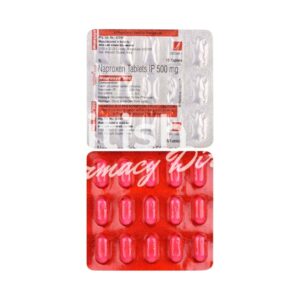
Naprosyn
In brief
- In our pharmacy, you can buy Naprosyn without a prescription, with delivery in 9–21 days throughout the United Kingdom. Discreet and anonymous packaging.
- Naprosyn is used for relief of pain and inflammation in conditions such as osteoarthritis, rheumatoid arthritis, ankylosing spondylitis, acute gout flares, dysmenorrhoea and juvenile idiopathic arthritis; it is a non‑steroidal anti‑inflammatory drug (NSAID) that inhibits COX‑1 and COX‑2, reducing prostaglandin synthesis.
- Usual adult doses are typically 250–500 mg twice daily for arthritis; acute gout often starts with 750 mg followed by 250 mg every 8 hours; for acute pain or dysmenorrhoea 500 mg initially then 250 mg every 6–8 hours as needed; paediatric dosing is weight‑based (about 10 mg/kg/day divided).
- Administration is oral: tablets (including gastro-resistant tablets), oral suspension for children.
- Onset of effect is generally within 30–60 minutes, with pain relief often noticeable within the first hour.
- Duration of action is long‑acting compared with some NSAIDs—analgesic effects commonly last about 8–12 hours (plasma half‑life ~12–17 hours), which allows twice‑daily dosing.
- Do not consume alcohol while taking Naprosyn or keep alcohol intake to a minimum, as alcohol increases the risk of gastrointestinal irritation and bleeding.
- The most common side effect is nausea.
- Would you like to try Naprosyn without a prescription?
Basic Naprosyn information
- INN (international nonproprietary name): Naproxen
- Brand names available in the United Kingdom: Naprosyn; Naprosyn EC; generic naproxen
- ATC code: M01AE02
- Forms and dosages: Tablets 250mg, 500mg; gastro-resistant (enteric-coated) tablets 250mg, 375mg, 500mg; oral suspension 125mg/5mL
- Manufacturers in the United Kingdom: Roche (originator); Teva; Sandoz; Torrent
- Registration status in the United Kingdom: Licensed by the MHRA
- OTC / Rx classification: Prescription-only medicine (POM) for most strengths and indications
Critical warnings and restrictions (safety first — UK focus)
High-risk groups (elderly, pregnancy, chronic illness)
Start with clear safety priorities: naproxen is an NSAID with known serious risks including gastrointestinal bleeding, cardiovascular harms and renal damage.
Always assess risk versus benefit before prescribing naproxen.
Use the checklist below before starting treatment or when renewing treatment for chronic use.
- Checklist for prescribers:
- 1. Confirm history of allergy to naproxen, aspirin or other NSAIDs.
- 2. Check current anticoagulant or antiplatelet therapy (warfarin, DOACs, aspirin).
- 3. Ask about prior peptic ulcer or gastrointestinal bleeding.
- 4. Screen for cardiovascular disease or uncontrolled hypertension.
- 5. Assess renal and hepatic impairment with appropriate tests.
Absolute contraindications from available product data include allergy to naproxen or other NSAIDs, active peptic ulcer or GI bleeding, recent coronary artery bypass grafting and severe heart failure.
Elderly patients require lower doses and closer monitoring because of increased GI and renal risks.
Pregnancy: avoid naproxen in the third trimester.
Breastfeeding: use with caution and clinical judgement.
Interaction with activities (driving, workplace safety under UK law)
Naproxen can cause dizziness or drowsiness in some people.
If affected, patients must not drive or operate heavy machinery.
Under the UK Road Traffic Act, drivers who are impaired by medicines may be prosecuted if they cause danger while driving.
For safety‑critical workers such as rail staff, pilots and HGV drivers, occupational health clearance and recording in workplace medical records is recommended.
Employers and occupational health teams should use the checklist below when someone is prescribed naproxen.
- Checklist for employers/occupational health:
- Confirm job tasks that are safety‑critical.
- Assess possible side effects (drowsiness, dizziness).
- Advise temporary restriction of duties if symptoms occur.
- Record medicine use in workplace medical records where required.
Q&A — “Can I drive after taking it in the UK?”
Q: Can I drive after taking naproxen?
A: Most patients can drive if they are not affected by side effects such as drowsiness or dizziness.
A: If you feel drowsy, dizzy or less alert, do not drive and do not operate machinery.
- Steps to take if impaired:
- Stop driving immediately and arrange safe transport home.
- Tell your prescriber or GP if symptoms persist.
- Report suspected adverse effects to the MHRA Yellow Card scheme.
Usage basics
INN, brand names available in the UK
The international nonproprietary name is naproxen.
Brands available in the UK include Naprosyn and Naprosyn EC, alongside generic naproxen.
Typical packaging for tablets is blister packs of 10, 20, 30 or 50 tablets and suspension bottles for paediatric use.
| INN | Typical UK brands | Common forms |
|---|---|---|
| Naproxen | Naprosyn; Naprosyn EC; generic naproxen | Tablets 250–500mg; gastro-resistant tablets; suspension 125mg per 5mL |
Note that naproxen sodium absorbs slightly faster than naproxen free acid but both are clinically similar in systemic exposure.
Legal classification (POM, P, GSL)
- POM (prescription only medicine): Most naproxen strengths and pack sizes are prescription only in the UK.
- P (pharmacy): Not typically applied to standard naproxen packs in the UK.
- GSL (general sales list): Naproxen does not generally appear as a GSL product in the UK.
UK pharmacies usually dispense naproxen on prescription.
Check MHRA licences and the electronic medicine compendia for current legal status.
- Brands often sold on prescription:
- Naprosyn
- Generic naproxen tablets from Teva, Sandoz, Accord and others
Dosing guide
Standard regimens (NHS guidelines)
Use the lowest effective dose for the shortest time necessary.
| Indication | Typical adult dose |
|---|---|
| Osteoarthritis / rheumatoid arthritis / ankylosing spondylitis | 250–500mg twice daily |
| Acute gout | 750mg initially, then 250mg every 8 hours |
| Mild–moderate pain / dysmenorrhoea | 500mg initially, then 250mg every 6–8 hours as needed |
| Juvenile idiopathic arthritis (paediatric) | Approximately 10mg/kg/day in two divided doses (use suspension by weight) |
For chronic arthritis, review regularly and keep to the lowest effective long‑term dose.
Adjustments for comorbidities
Start at lower doses for elderly patients and monitor closely for adverse effects.
Avoid naproxen in severe renal impairment.
Consider dose reduction and careful monitoring in hepatic impairment.
Avoid combining naproxen with other NSAIDs to limit additive risk.
- Monitoring schedule checklist for chronic use:
- Baseline blood pressure and renal function (eGFR) before starting.
- Repeat BP and renal tests within 1–3 months after initiation.
- Periodic checks every 6–12 months for long‑term therapy, more often if comorbidities exist.
Q&A — “What if I miss a dose?”
Q: Missed dose?
A: Take the dose as soon as you remember unless the next scheduled dose is near.
A: Do not double up doses to make up for a missed dose.
A: For overdose symptoms such as severe stomach pain, persistent vomiting, dizziness, confusion or seizures seek urgent medical attention; treatment is supportive as there is no specific antidote.
Interaction chart
Food and drinks (alcohol, tea/coffee, diet habits)
Alcohol increases the risk of gastrointestinal bleeding when combined with naproxen.
Advise patients to minimise alcohol intake while taking naproxen.
There are no major food interactions, but taking naproxen with food or milk reduces gastric irritation.
Caffeine can mask pain and should not be used instead of correct dosing.
- Patient counselling points:
- Take naproxen with or after food to reduce stomach upset.
- Limit alcohol while using naproxen to reduce bleeding risk.
- Remain hydrated and report reduced urine output or swelling.
Common drug conflicts
| Drug class | Effect with naproxen | Monitoring / action |
|---|---|---|
| Anticoagulants / antiplatelets (warfarin, DOACs, aspirin) | Increased bleeding risk | Review need for combined therapy and monitor INR/bleeding signs closely |
| SSRIs | Increased upper GI bleeding risk | Consider GI protection and counsel on bleeding signs |
| ACE inhibitors / ARBs / diuretics | Risk of reduced renal function and loss of antihypertensive effect | Monitor BP and renal function after initiation |
| Lithium / Methotrexate | Increased plasma levels and toxicity risk | Monitor drug levels and consider dose adjustments |
| Corticosteroids | Increased GI ulceration and bleeding risk | Assess GI risk and consider PPI co‑prescription |
Encourage reporting of suspected adverse drug reactions to the MHRA Yellow Card scheme.
Legal status and availability in the UK
In our online pharmacy, Naprosyn is available without a prescription, with discreet delivery to the United Kingdom in 9–21 days.
Mechanism and pharmacology
Simplified explanation
Naproxen inhibits cyclo‑oxygenase enzymes COX‑1 and COX‑2.
This reduces prostaglandin synthesis and decreases inflammation, pain and fever.
COX‑1 inhibition explains adverse effects such as reduced gastric protection and platelet effects.
COX‑2 inhibition explains the anti‑inflammatory and analgesic benefits.
- Definitions:
- COX: Cyclo‑oxygenase enzyme that produces prostaglandins.
- Prostaglandins: Local hormones that promote inflammation and protect the stomach lining.
- Half‑life: Naproxen has a relatively long half‑life allowing twice‑daily dosing.
Clinical terms
Naproxen’s relatively long half‑life supports twice‑daily dosing schedules for adults.
Different salts affect absorption speed: naproxen sodium absorbs faster than naproxen free acid but systemic exposure is similar.
ATC classification is M01AE02 among anti‑inflammatory antirheumatic products.
Gastro-resistant (enteric-coated) formulations such as Naprosyn EC are designed to reduce stomach irritation.
- Glossary:
- ATC: Anatomical Therapeutic Chemical classification (M01AE02 for naproxen).
- Enteric‑coated (EC): Coating to reduce stomach irritation and delay release.
- Extended‑release: Formulation to release drug over longer period.
Indications and off‑label uses
MHRA‑approved uses
Approved indications include inflammatory musculoskeletal conditions such as osteoarthritis, rheumatoid arthritis and ankylosing spondylitis.
Other approved uses include acute gout, primary dysmenorrhoea and short‑term relief of mild to moderate pain.
Standard dosing per indication aligns with the typical regimens summarised earlier.
Off‑label practices in NHS / private care
Off‑label use may occur in paediatric inflammatory conditions under specialist supervision using weight‑based dosing.
| Indication | Typical NHS dose | Rx / OTC status |
|---|---|---|
| Osteoarthritis | 250–500mg twice daily | Prescription only |
| Acute gout | 750mg then 250mg q8h | Prescription only |
| Juvenile idiopathic arthritis | ~10mg/kg/day in two divided doses | Specialist prescription |
Document informed consent and the rationale for any off‑label prescribing in the patient record as per MHRA guidance.
Alternatives matrix
NHS prescribing alternatives (comparison table)
| Drug | Typical NHS dose | GI risk vs naproxen | CV considerations | Renal considerations |
|---|---|---|---|---|
| Ibuprofen | 200–400mg every 4–6h | Similar or slightly lower in short‑term use | Small CV risk with long‑term use | Avoid in severe renal impairment |
| Diclofenac | 75–150mg daily (varies by formulation) | Potentially higher GI risk for some patients | Higher CV risk signals reported | Use cautiously if renal impairment |
| Celecoxib | 200mg daily (varies) | Lower GI ulceration risk versus non‑selective NSAIDs | CV risk still present; careful in CVD patients | Use with caution in renal disease |
| Meloxicam | 7.5–15mg daily | Preferential COX‑2 effects may reduce GI risk | CV risk considerations similar to celecoxib | Monitor renal function |
Pros and cons checklist
- Consider efficacy for the specific condition when choosing an alternative.
- Assess GI and cardiovascular risk profiles for each option.
- Review renal function and potential drug interactions.
- Account for patient preference and adherence factors.
- Consult NICE and local formularies to align with local prescribing policy.
- Consider PPI co‑prescription when GI risk is elevated.
Common questions
Patients ask a few recurrent practical questions about naproxen.
- Is naproxen suitable for period pain?
- Yes. Naproxen is effective for primary dysmenorrhoea with typical regimen 500mg then 250mg PRN within recommended limits.
- Can I take naproxen with my blood pressure tablets?
- Caution is advised because NSAIDs can reduce the efficacy of some antihypertensives and worsen renal function; discuss with your GP and monitor blood pressure after starting naproxen.
- Can children take naproxen?
- Use the paediatric suspension and dose by weight; not routinely recommended under 2 years and specialist advice is needed for juvenile idiopathic arthritis dosing (~10mg/kg/day).
Signpost patients to NHS written information where appropriate.
Registration and regulation
MHRA approval process
Naproxen products placed on the UK market are regulated and require a marketing authorisation.
Marketing authorisation holders must comply with pharmacovigilance obligations and report safety data.
Manufacturers listed in product information include Roche, Teva, Sandoz and Torrent.
Patients and clinicians are encouraged to report adverse reactions to the MHRA Yellow Card scheme.
NHS prescribing framework
Prescribers should consult the MHRA summary of product characteristics (SmPC), local formularies and NICE guidance when prescribing naproxen.
Document allergy status, interactions and a monitoring plan.
- Clinician checklist before prescribing:
- Check SmPC and local formulary position.
- Confirm patient allergies and current medicines.
- Agree monitoring schedule (BP, renal function, GI symptoms).
- Provide written information and document consent for off‑label use.
Storage and handling
UK household storage (cold/damp climate)
Store naproxen at 15°C–30°C and protect it from excessive heat and moisture.
UK homes can be humid, so keep medicines in a dry room away from the bathroom sink or boiler.
Keep naproxen in its original container with child‑resistant packaging where supplied and out of reach of children.
- Storage steps:
- Store in a closed cupboard away from direct sunlight and moisture.
- Do not store in the bathroom or near a radiator.
- Check expiry dates before use.
Guidance from NHS and pharmacists
Check the expiry date and batch number when supplied by the pharmacy.
Transport medicines in their original packaging to preserve labelling and instructions.
Return unwanted or expired medicines to a pharmacy take‑back scheme — do not flush medicines down the toilet.
- Definitions:
- Expiry date: The date after which a medicine should not be used.
- Batch number: Manufacturer reference for tracing supplies.
- Storage conditions: As stated on the label and in the SmPC.
Guidelines for proper use (pharmacist and patient counselling)
UK pharmacist counselling style
Pharmacists should confirm the indication and planned duration before handing over naproxen.
Check for allergies to aspirin or other NSAIDs and review concomitant medicines for interactions.
Advise taking naproxen with food to reduce gastric irritation.
Warn about alcohol and the risk of additive GI harm if combined with other NSAIDs or corticosteroids.
- Patient handover checklist:
- Indication and duration of treatment.
- Recommended dosing and missed dose advice.
- Common and serious side effects to watch for.
- When to seek urgent medical care.
NHS patient safety advice
For chronic prescriptions, arrange baseline monitoring and periodic checks including blood pressure, eGFR and liver function tests as indicated.
Provide written patient information that highlights red flags such as black or tarry stools, vomiting blood, chest pain, sudden breathlessness and reduced urine output.
Encourage patients to report side effects via the MHRA Yellow Card and to keep regular contact with their GP or pharmacist for prescription renewals and monitoring.
Delivery across the United Kingdom
| City | Region | Delivery Time |
|---|---|---|
| London | England | 9–21 days |
| Birmingham | England | 9–21 days |
| Manchester | England | 9–21 days |
| Glasgow | Scotland | 9–21 days |
| Edinburgh | Scotland | 9–21 days |
| Liverpool | England | 9–21 days |
| Bristol | England | 9–21 days |
| Leeds | England | 9–21 days |
| Sheffield | England | 9–21 days |
| Newcastle Upon Tyne | England | 9–21 days |
| Belfast | Northern Ireland | 9–21 days |
| Cardiff | Wales | 9–21 days |
| Coventry | England | 9–21 days |
| Leicester | England | 9–21 days |
| Nottingham | England | 9–21 days |
Closing notes
Naproxen is a well‑established NSAID effective for a range of inflammatory and pain conditions when used appropriately.
Assess individual risk for GI, cardiovascular and renal adverse events before starting therapy and monitor during treatment.
Always document the decision, counsel patients on red flags and report suspected adverse reactions.
For further information consult product SmPCs and national guidance and use the MHRA Yellow Card scheme to report safety concerns.