Tropicamide
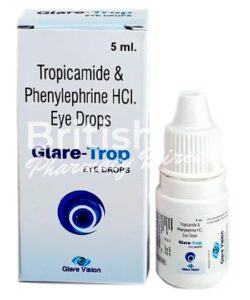
In stock
1%
from 28,28 £
In brief
- Tropicamide is a short-acting antimuscarinic eye drop that enlarges the pupil and briefly relaxes focusing, mainly for eye tests.
- A 1% solution, available as a single bottle or in sets of two to five.
- Prescription-only in the UK, where Mydriacyl 1% and Minims Tropicamide are licensed; the bottles offered here are imported.
Tropicamide: dilating drops for examining the eye
Tropicamide blocks the action of acetylcholine on the muscles inside the eye. With the ring muscle of the iris switched off, the pupil opens wide (mydriasis); with the ciliary muscle relaxed, the eye temporarily loses its ability to focus close up (cycloplegia). Both effects come on quickly and wear off within hours, which is why the drops are a standard part of eye examinations. The UK SmPC lists two uses: diagnostic work, namely looking at the back of the eye (fundoscopy) and measuring a prescription for glasses with focusing relaxed (cycloplegic refraction), and use before and after eye surgery when a short-acting dilating drop is needed.
The 1% bottles in this listing
The drops on this page are the 1% strength, sold singly or in sets of two, three, four or five bottles. They are an imported product. In the UK this medicine is a POM, licensed as Mydriacyl 1% in a multi-dose bottle and as Minims single-use units in 0.5% and 1%, with other 1% single-dose products also listed on the electronic medicines compendium.
How the drops are put in
To relax focusing before a refraction test, one or two drops of the 1% solution go into the eye, followed by the same again five minutes later, according to the SmPC. An extra drop keeps the effect going if 20 to 30 minutes pass before the examination. Examining the retina usually needs only the 0.5% strength, given 15 to 20 minutes beforehand. In small infants nothing stronger than 0.5% should be used, and in children the drops may not relax focusing fully, so atropine is sometimes preferred. After putting the drop in, close the eye gently or press on the inner corner for a couple of minutes to reduce absorption into the bloodstream. Different eye products should be spaced at least five minutes apart, with any ointment going in last.
Who should not use the drops
Tropicamide must not be used by anyone with glaucoma or a narrow drainage angle, because widening the pupil can trigger an attack of angle-closure glaucoma, and older people may have glaucoma that has not yet been picked up. Should the eye become red and sore after the drops, with misty sight, coloured rings around lights, headache or sickness, go straight to an eye casualty department or A&E. Extra care applies to babies, young children, people with Down syndrome and those sensitive to belladonna-type medicines, as systemic effects are more likely; parents should wash their own and the child’s hands after use. Its antimuscarinic action can be strengthened by medicines that share it, for example amantadine, phenothiazines, certain antihistamines and tricyclic antidepressants. Where drops contain benzalkonium chloride, as Mydriacyl does, soft contact lenses should be taken out and left out for at least 15 minutes.
Vision, driving and everyday life afterwards
Expect blurred sight and glare while the pupils are large; the SmPC says full recovery can take up to six hours. Driving or using machinery should wait until vision is clear again, and sunglasses help in bright light. Once a bottle of tropicamide is opened, follow the storage and discard instructions on its label; the UK Mydriacyl bottle, for example, should be discarded four weeks after opening.
Unwanted effects linked to tropicamide
Locally there may be stinging, eye pain or irritation, redness, light sensitivity and pupils that stay wide for longer than expected. Beyond the eye, people have described headache, feeling dizzy or sick, a drop in blood pressure and even fainting. Children are more prone to whole-body antimuscarinic effects, such as flushing, a dry mouth, a fast heartbeat and, rarely, behavioural disturbances. The clinician decides whether tropicamide is suitable.