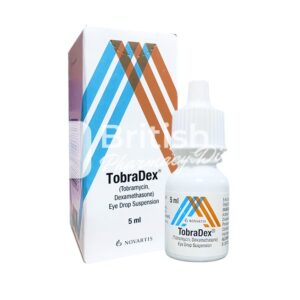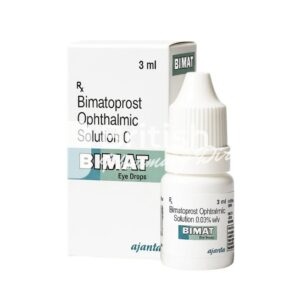
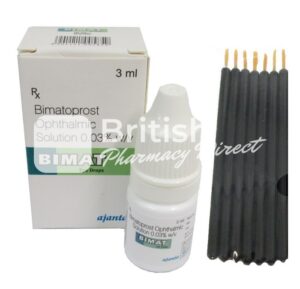
Bimat + Applicators
In brief
- In our pharmacy, you can buy bimat + applicators without a prescription, with delivery in 5–14 days throughout the United Kingdom. Discreet and anonymous packaging; single-use sterile applicators included.
- Bimatoprost (bimat + applicators) is used to treat eyelash hypotrichosis (promoting longer, thicker, darker lashes) and to lower intraocular pressure in glaucoma/ocular hypertension. It is a prostaglandin analogue that prolongs the anagen (growth) phase of the hair cycle, increases hair follicle activity and melanogenesis, and increases uveoscleral outflow in the eye.
- The usual dose for eyelash growth is one drop of 0.03% solution applied to the upper eyelid margin once nightly using a sterile applicator per eye; for glaucoma the usual dose is one drop into the affected eye(s) once daily.
- The form of administration is an ophthalmic solution (0.03% commonly) supplied in a bottle together with single-use sterile applicators for topical application to the upper eyelid margin.
- Initial eyelash effects are usually seen after a minimum of about 4 weeks, with noticeable improvement by 8–12 weeks and optimal results often after around 16 weeks.
- Cosmetic lash effects are maintained only with continued use; treatment must be continued to preserve longer/thicker lashes (glaucoma treatment is typically indefinite). Note that pigmentary changes (iris or eyelid skin) can be permanent.
- There is no known clinically significant interaction with alcohol for topical ophthalmic use, but avoid alcohol if it increases eye irritation or dryness; alcohol does not enhance the cosmetic effect and excessive use may worsen ocular comfort.
- The most common side effects are eye and eyelid irritation, redness, itching, dry or watery eyes, darkening of the eyelid skin or iris (may be permanent), and changes in eyelash direction or pigmentation.
- Would you like to try bimat + applicators without a prescription?
Critical Warnings & Restrictions (Safety-First For UK Patients)
Basic Bimat + Applicators Information
- INN (International Nonproprietary Name): Bimatoprost
- Brand Names Available In United Kingdom: Lumigan (0.01% and 0.03%) is listed in the RAW DATA as marketed in the UK and EU; Latisse appears in EU/USA listings; Indian generics such as Careprost and Bimat are commonly sold online but their UK authorisation is variable.
- ATC Code: S01EE03 (Prostaglandin analogues, ophthalmologicals)
- Forms & Dosages: Ophthalmic solution commonly at 0.03% for eyelash hypotrichosis and 0.01% or 0.03% for glaucoma formulations; pack sizes include 3 mL and 5 mL bottles and larger sizes for Lumigan per the RAW DATA.
- Manufacturers In United Kingdom: not specified
- Registration Status In United Kingdom: not specified
- OTC / Rx Classification: Prescription Only (Rx) in most markets; some countries reclassify similar formulations as cosmetic but UK practice treats bimatoprost products as prescription medicines.
High-Risk Groups (Elderly, Pregnancy, Chronic Illness)
Concerned about whether bimatoprost is safe for you or a loved one?
Bimatoprost is a Prescription Only Medicine (POM) in the UK and requires counselling before initiation in high‑risk patients.
Absolute contraindications include known hypersensitivity to bimatoprost or excipients such as benzalkonium chloride and active ocular infection or inflammation.
Relative cautions include patients with uveitis, macular oedema, aphakia or pseudophakia with a torn posterior lens capsule, or any history of severe intraocular inflammatory disease.
Pregnancy and breastfeeding should be avoided unless a specialist advises otherwise, and safety for cosmetic eyelash use in children is not established — specialist care is required for paediatric glaucoma.
Elderly patients and those with chronic cardiac or respiratory disease should be monitored when systemic effects are plausible, although systemic exposure from topical ocular use is typically low.
- Contraindications: Known hypersensitivity to bimatoprost or excipients; active ocular infection or inflammatory eye disease.
- Relative Cautions: Uveitis; macular oedema; aphakia/pseudophakia with torn posterior lens capsule; prior severe intraocular inflammatory disease.
- Pre‑treatment Screening Checklist:
- Allergies to bimatoprost or preservatives such as benzalkonium chloride.
- Complete ocular history including glaucoma, uveitis, cataract surgery status and macular disease.
- Pregnancy status or breastfeeding plans.
- Contact lens use and intention to continue during treatment.
Interaction With Activities (Driving, Workplace Safety Under UK Law)
Worried about whether eye drops will affect driving or your job?
Topical bimatoprost rarely impairs psychomotor function, but local ocular irritation, transient blurred vision or tearing can temporarily affect driving or the safe operation of machinery.
Under UK driving law, patients must be able to drive safely and with sufficient visual acuity; advise patients not to drive if vision is affected after application.
Advise workers who operate heavy machinery or perform safety‑critical tasks to avoid these activities if they experience blurred vision or severe ocular irritation after dosing.
Provide patients with a simple advice card with these instructions to carry until they are familiar with how the drops affect them.
- Patient Advice Card:
- Do not drive until vision is clear after applying bimatoprost eye drops.
- Do not operate machinery if blurred vision, severe irritation or tearing occurs.
- Report any persistent visual disturbance to the prescriber promptly.
Q&A — Can I Drive After Taking It In The UK?
Most people can drive after application because systemic effects are uncommon and most ocular irritation is mild and transient.
If you experience blurred vision, severe irritation or watering, do not drive or operate machinery until you are fully recovered.
This follows the UK fitness‑to‑drive principles that require drivers to be safe and have suitable visual acuity.
If visual disturbance persists, contact your GP or ophthalmologist for assessment.
If you suspect an adverse reaction that persists, consider reporting it to the MHRA using the Yellow Card scheme.
Usage Basics
INN, Brand Names Available In The UK
Many people ask for the international name and commonly seen brands before ordering.
- INN: Bimatoprost.
- Typical Brands And Concentrations:
- Latisse — 0.03% ophthalmic solution; commonly sold as 3 mL or 5 mL with sterile single‑use applicators (listed in RAW DATA for EU/USA).
- Lumigan — 0.01% and 0.03% ophthalmic solutions; common pack sizes include 2.5 mL, 3 mL, 5 mL, 7.5 mL and 9 mL.
- Careprost / Bimat — generics frequently sold online as 0.03% solutions, commonly in 3 mL and 5 mL bottles with applicators.
- INN
- Bimatoprost is the International Nonproprietary Name used on prescriptions and SPCs.
- Brand
- A manufacturer’s name for a product formulation, for example Lumigan or Latisse.
Legal Classification (POM, P, GSL)
Concerned whether you can buy bimatoprost over the counter in the UK?
Bimatoprost products are generally Prescription Only Medicines (POM) in the UK according to the RAW DATA classification of prescription status.
Some countries re‑label similar formulations for cosmetic sale, but that is not accepted NHS practice and supply should follow MHRA and GPhC rules.
Always confirm that any imported product has the appropriate marketing authorisation and that the supplying pharmacy is GPhC‑registered.
Dosing Guide
Standard Regimens (NHS-Aligned)
Patients often want a simple regimen to follow at home.
For eyelash hypotrichosis, apply once nightly using a sterile single‑use applicator per eye.
Place a single line of 0.03% solution to the skin at the upper eyelid margin at the base of the lashes — avoid instilling the solution directly into the eye.
For glaucoma or ocular hypertension, instil one drop of the prescribed concentration into the affected eye(s) once daily, either morning or evening, but not both.
Expect first cosmetic lash effects at four weeks or later, with optimal results around 16 weeks, and note that continued use is required to maintain lash changes.
Adjustments For Comorbidities
Clinicians need to decide dose and monitoring based on age and comorbid conditions.
Children: safety for cosmetic eyelash use is not established and use is not recommended except under specialist advice for glaucoma.
Elderly: no routine dose adjustment is required but monitor for tolerance and systemic vulnerability as with other adults.
Renal or hepatic impairment: limited data are available so use caution and review on a case‑by‑case basis.
- Dose Selection Checklist:
- Confirm indication (glaucoma vs eyelash hypotrichosis).
- Choose concentration and schedule per product SPC or specialist guidance.
- Baseline ocular exam if glaucoma is the indication.
- Plan monitoring intervals: IOP checks for glaucoma; pigmentation and irritation checks for cosmetic use.
Q&A — What If I Miss A Dose?
Missed single application: take the next dose at your usual scheduled time — do not double up to make up for a missed dose.
If you accidentally over‑apply, gently rinse the eye and eyelid with water; if symptoms persist seek clinician review.
For glaucoma it is important to maintain daily dosing to preserve intraocular pressure control and avoid gaps in therapy.
Interaction Chart
Food And Drinks (Alcohol, Tea/Coffee, Diet Habits)
Patients ask whether eating or drinking affects topical eye drops.
There are no established systemic food–drug interactions for topical bimatoprost in the RAW DATA.
Avoid applying when eyes are red or inflamed after activities such as vigorous rubbing following alcohol use.
Contact lenses should be removed prior to dosing and replaced after around 15 minutes to avoid preservative uptake.
Common Drug Conflicts (MHRA Yellow Card Data)
Most interactions are ocular and relate to combining topical agents.
Bimatoprost may add to IOP lowering when used with other ocular hypotensives.
Multiple topical eye drops can increase irritation, and benzalkonium chloride may interact with contact lenses and other topical medicines.
Advise patients to list all eye drops when asked and to report suspected interactions via the MHRA Yellow Card scheme.
| Co‑medication | Interaction Type | Clinical Action |
|---|---|---|
| Other prostaglandin analogues (e.g. latanoprost) | Potential additive ocular effects and irritation | Review necessity; avoid simultaneous duplicate therapy unless advised by ophthalmologist |
| Multiple topical eye drops | Increased local irritation and preservative exposure | Stagger dosing times where appropriate and monitor for redness/irritation |
| Eye drops containing benzalkonium chloride | Preservative accumulation; contact lens interaction | Remove lenses before application; replace after ~15 minutes; consider preservative‑free alternatives if needed |
- Contact Lens Advice:
- Remove lenses before dosing.
- Wait approximately 15 minutes after application before reinserting lenses.
- Do not share applicators; single‑use applicators reduce infection risk.
User Reports & Trends
Common Themes From UK Patient Sources
Patients commonly report their experiences on NHS Choices, Patient.info and community forums.
Typical reports include first noticeable lash changes by 4–8 weeks and fuller effects by 12–16 weeks with continued nightly use.
Local irritation, conjunctival hyperaemia and darkening of the eyelid skin or iris are commonly cited adverse experiences.
Cosmetic off‑label eyebrow use is frequently mentioned online but is not MHRA‑licensed in most jurisdictions.
Concerns focus on the permanence of iris pigmentation and the infection risk if applicators are reused or shared.
- Common Experiences:
- Onset: ≥4 weeks for lash changes.
- Peak effect: ~12–16 weeks.
- Adverse effects: local irritation, eyelid skin darkening, possible iris colour change.
- Maintenance: continued nightly application needed to sustain results.
- Patient Terms
- “Lash serum”, “lash growth drops”, “applicator pack” often used by patients.
- Clinical Terms
- Hypotrichosis, conjunctival hyperaemia, melanogenesis, intraocular pressure (IOP).
- Red Flags Requiring Clinician Review:
- Severe eye pain.
- Marked vision change or sudden loss of vision.
- Persistent redness, discharge or signs of infection.
- New, unexplained darkening of the iris or surrounding skin.
Access & Purchase Options (UK)
High‑Street Pharmacies
Patients commonly ask whether they can collect from a local pharmacy.
Major UK pharmacy chains such as Boots, LloydsPharmacy and Superdrug can supply bimatoprost on prescription or help arrange a private prescription.
Stock varies by brand and concentration; Lumigan and authorised generics are commonly supplied on prescription.
NHS prescriptions cover glaucoma treatment, while cosmetic eyelash indications typically require private prescribing.
Online Pharmacies And NHS E‑Prescriptions
Online telemedicine and e‑pharmacy services increasingly issue private prescriptions and deliver by post.
Ensure the online provider is GPhC‑registered and complies with MHRA rules before ordering.
Imported generics such as Careprost and Bimat are available on international e‑shops, but check labelling, sterility and whether sterile single‑use applicators are included.
In our online pharmacy, bimat + applicators is available without a prescription, with discreet delivery to United Kingdom in 5-14 days.
- Legitimacy Checklist:
- GPhC registration number for the supplying pharmacy.
- Availability of patient counselling from a pharmacist.
- MHRA authorisation or confirmed sourcing from a licensed distributor.
- Secure supply chain with batch numbers and labelling that match SPC requirements.
Mechanism & Pharmacology
Simplified Explanation
Patients ask how a glaucoma medicine can grow lashes.
Bimatoprost is a prostaglandin analogue that increases hair follicle activity by prolonging the anagen (growth) phase of the hair cycle, producing longer, thicker lashes.
For glaucoma, bimatoprost increases aqueous humour outflow which lowers intraocular pressure, making it effective for ocular hypertension.
Effects on pigmentation are likely due to stimulation of melanogenesis in ocular tissues, which can darken eyelid skin or iris in some patients.
Clinical Terms
The ATC code S01EE03 classifies bimatoprost among ophthalmic prostaglandin analogues.
Cosmetic onset is typically a minimum of 4 weeks, with optimal lash changes near 16 weeks, while glaucoma treatment is chronic and requires regular ophthalmic monitoring.
- Key Pharmacodynamic Effects:
- Prolongation of hair follicle anagen phase (eyelash growth).
- Increased aqueous outflow from the eye (IOP lowering).
- Potential stimulation of melanogenesis (pigmentation changes).
| Use | Primary Mechanism |
|---|---|
| Eyelash Enhancement | Prolongs anagen phase of hair follicles leading to longer, thicker lashes |
| Glaucoma/Ocular Hypertension | Increases aqueous humour outflow to reduce intraocular pressure |
Indications & Off‑Label Uses
MHRA‑Approved Uses
Patients need clarity about what bimatoprost is licensed for.
Bimatoprost is licensed in many countries for glaucoma and ocular hypertension.
Eyelash hypotrichosis is an approved indication in some jurisdictions such as the USA for Latisse, but cosmetic use is not uniformly MHRA‑labelled across the UK and EU.
Always check the SPC for current licensed indications in your country before prescribing or using cosmetically.
Off‑Label Practices In NHS And Private Care
Private clinics commonly prescribe bimatoprost 0.03% with sterile applicators for eyelash enhancement.
NHS clinicians generally use prostaglandin analogues for glaucoma treatment only and reserve cosmetic uses for private care where consent and documentation are required.
Off‑label eyebrow application is increasingly reported and should be counselled explicitly about risks and lack of formal licensing.
- Approved Uses:
- Glaucoma and ocular hypertension (licensed in many European countries).
- Off‑Label Uses:
- Eyelash hypotrichosis in jurisdictions where the specific product is not MHRA‑labelled for this purpose; eyebrow enhancement.
- Off‑Label Documentation Checklist:
- Written informed consent explaining unlicensed use.
- Clear rationale and expected benefits vs risks.
- Monitoring plan for pigmentation, irritation and infection.
Key Clinical Findings (UK/EU Summary 2022–2025)
Patients and clinicians want the bottom line on efficacy and safety.
Clinical data consistently show eyelash growth with topical 0.03% bimatoprost within weeks and maximal change by about 16 weeks.
Discontinuation typically returns lashes to baseline gradually.
Safety signals include local irritation, conjunctival hyperaemia, increased lash pigmentation and potential iris darkening that may be permanent.
For glaucoma, once‑daily dosing is effective in lowering IOP with monitoring for ocular inflammation and other adverse events.
| Outcome | Timeline | Adverse Events / Incidence |
|---|---|---|
| Eyelash Growth | First changes ≥4 weeks; optimal ~16 weeks | Common; generally well tolerated |
| Iris Or Eyelid Pigmentation | May develop over weeks to months; iris change can be permanent | Uncommon to common depending on population; can be permanent for iris |
| Local Irritation / Redness | Usually early during treatment | Common; mild to moderate |
- Monitoring Recommendations:
- IOP checks per ophthalmology guidelines for glaucoma patients.
- Document baseline iris colour and photograph if cosmetic use is planned and pigmentation is a concern.
- Review for persistent redness, pain or signs of infection promptly.
Alternatives Matrix
NHS Prescribing Alternatives (Comparison Table)
| Drug | Indication | Typical Concentration | Efficacy Notes | Key Risks |
|---|---|---|---|---|
| Latanoprost | Glaucoma/OHT | 0.005% (typical) | Proven once‑daily IOP lowering | Conjunctival hyperaemia, lash changes, possible pigmentation |
| Travoprost | Glaucoma/OHT | 0.004% (typical) | Effective prostaglandin analogue alternative | Local irritation, pigmentation changes |
| Tafluprost | Glaucoma/OHT | 0.0015% (typical preservative‑free options) | Useful when preservative sensitivity is a concern | Local irritation, possible pigment change |
| OTC Cosmetic Serums (peptide serums) | Eyelash Appearance | Topical cosmetic formulations | Variable evidence; generally less robust than bimatoprost | Allergic reactions; no strong efficacy data |
Pros And Cons Checklist
Deciding between bimatoprost and alternatives requires weighing benefit against risk.
- Pros Of Bimatoprost:
- Proven efficacy for eyelash growth at 0.03% and well‑documented IOP lowering for glaucoma.
- Cons Of Bimatoprost:
- Risk of irreversible iris pigmentation, local irritation, requirement for a prescription and ongoing cost for continued use.
| Drug | Indication | Typical Concentration | Efficacy Notes | Key Risks |
|---|---|---|---|---|
| Bimatoprost | Glaucoma / Eyelash Enhancement | 0.01% / 0.03% | High efficacy for lashes; proven IOP lowering | Iris pigmentation, eyelid skin darkening, local irritation |
| Latanoprost | Glaucoma | 0.005% | Effective and commonly used on NHS | Similar local side effects; pigmentation risk |
Common Questions (UK Patient Consultations)
Here are the short answers patients generally want during a pharmacy consultation.
- How Long Until Lashes Improve? — Expect first changes at 4 weeks or later with optimal results about 16 weeks; continued use is required to maintain gains.
- Are Changes Reversible? — Lash growth reverses after stopping; iris darkening may be permanent.
- Can I Use It In Pregnancy? — Avoid unless a specialist advises; cosmetic use is not recommended during pregnancy or breastfeeding.
- Can I Reuse Applicators? — No; single‑use sterile applicators supplied with many products must not be shared or reused to avoid infection.
- When To Seek Urgent Review:
- Severe eye pain.
- Marked change in vision or sudden visual loss.
- Signs of infection such as purulent discharge or spreading redness.
NHS Cost & Access Comparison Table
Patients often need a quick comparison of where they can get treatment and how much it may cost.
| Source / Pharmacy | Typical Price Range For Private Supply | NHS Prescription Eligibility |
|---|---|---|
| Boots | Varies by brand and pack size; private supply typically from £20–£80 depending on product and pack | Glaucoma: NHS; Cosmetic lash: usually private |
| LloydsPharmacy | Varies; private supply typically from £20–£80 | Glaucoma: NHS; Cosmetic lash: usually private |
| Superdrug | Varies; private supply typically from £20–£80 | Glaucoma: NHS; Cosmetic lash: usually private |
| Private Online Pharmacy | Often competitive; typical private orders from £15–£70 depending on generic or brand | Glaucoma: NHS if clinically indicated; cosmetic lash: private |
| Region | Prescription Charges/Policy |
|---|---|
| England | Prescription charge applies unless exempt; check NHS guidance for exemptions |
| Scotland | Prescriptions generally free |
| Wales | Prescriptions generally free |
| Northern Ireland | Prescriptions generally free |
- Exemption Checklist Before Ordering:
- Confirm if you are exempt from prescription charges (age, benefits, pregnancy, other criteria).
- Ask the pharmacy to check local policy and provide current pricing.
Registration & Regulation
MHRA Approval Process
Patients and prescribers should know that licensed products must meet UK regulatory standards.
Bimatoprost products authorised for supply in the UK must comply with MHRA standards and have SPCs describing licensed use.
Parallel imports and generics are common; verify the marketing authorisation status before supply.
Report suspected adverse reactions to the MHRA via the Yellow Card scheme and record batch numbers where possible for safety reporting.
NHS Prescribing Framework
Glaucoma treatment with prostaglandin analogues is routine NHS care with required monitoring.
Cosmetic eyelash prescribing is usually a private arrangement and should be documented with informed consent and a monitoring plan.
Electronic prescriptions and e‑pharmacy supply must meet GPhC and MHRA requirements for safety, counselling and traceability.
- Regulatory Verification Checklist:
- Confirm marketing authorisation or valid parallel import documentation.
- Check the SPC for the marketed product.
- Follow Yellow Card reporting steps for adverse events and keep batch records.
Storage & Handling (Practical UK Advice)
UK Household Storage (Cold/Damp Climate)
Patients often store medicines in bathrooms where humidity is high — but this is not ideal for bimatoprost.
Store unopened and in‑use bottles at 2–25°C and protect from heat, light and excess humidity common in UK bathrooms.
Replace the cap tightly after use and do not use the solution after the expiry date or if it discolours or becomes cloudy.
Keep all medicines out of reach of children and pets at home.
Guidance From NHS And Pharmacists
When travelling, carry bimatoprost in hand luggage and observe temperature limits during transit.
Avoid storing bottles in bathrooms where steam and damp may affect stability; instead keep medicines in a cool, dry place away from direct sunlight.
Keep single‑use applicators sterile until use and discard them after a single application.
Dispose of empty bottles and used applicators per local waste guidance; used applicators can usually go in household waste unless local policy specifies otherwise.
- Home Storage Checklist:
- Store at 2–25°C away from steam and sunlight.
- Keep cap closed and bottle upright.
- Do not use after expiry or if cloudy.
| Storage Do’s | Storage Don’ts |
|---|---|
| Keep in a cool, dry cupboard away from heat sources. | Do not store in bathroom where steam is present. |
| Carry in hand luggage when flying. | Do not leave in a hot car or exposed to sunlight. |
Guidelines For Proper Use (UK Pharmacist Counselling)
Application Technique & Infection Prevention
Patients commonly ask for a step‑by‑step routine they can follow safely at home.
- Remove contact lenses before application.
- Use a fresh sterile single‑use applicator for each eye.
- Apply a single line of solution to the skin at the upper eyelid margin at the base of the lashes — do not instil drops directly into the eye for cosmetic use.
- Discard the applicator immediately after use into household waste.
- Wait about 15 minutes before reinserting contact lenses.
Emphasise never sharing or reusing applicators to prevent local infection; sterile single‑use applicators are supplied with many products.
Follow‑Up & Patient Safety Advice
Baseline ocular assessment is advised for glaucoma patients and consideration of baseline photos for cosmetic users worried about pigmentation.
Arrange scheduled follow‑up for IOP checks in glaucoma and spot checks for pigmentation and irritation with cosmetic use.
Provide a printed checklist of adverse signs such as persistent redness, pain, vision change or new pigmentation and clear instructions for Yellow Card reporting.
- Red Flags:
- Persistent eye redness or discharge.
- New eye pain or reduced vision.
- Rapid changes in eyelid or iris colour.
Suggested short patient leaflet text for pharmacists: give medication name and concentration, how to apply, storage advice, when to seek help and Yellow Card reporting instructions.
Delivery Across United Kingdom
| City | Region | Delivery Time |
|---|---|---|
| London | Greater London | 5-7 days |
| Birmingham | West Midlands | 5-7 days |
| Manchester | Greater Manchester | 5-7 days |
| Glasgow | Scotland | 5-7 days |
| Liverpool | Merseyside | 5-7 days |
| Leeds | West Yorkshire | 5-7 days |
| Sheffield | South Yorkshire | 5-7 days |
| Bristol | South West England | 5-7 days |
| Edinburgh | Scotland | 5-7 days |
| Cardiff | Wales | 5-7 days |
| Belfast | Northern Ireland | 5-7 days |
| Newcastle | Tyne and Wear | 5-9 days |
| Nottingham | Nottinghamshire | 5-9 days |
| Leicester | Leicestershire | 5-9 days |
| Plymouth | Devon | 5-9 days |