Sertraline
In stock
25mg · 50mg · 100mg
from 33,63 £
In brief
- Sertraline is an SSRI antidepressant, prescription-only (POM) in the UK, supplied here as imported generic tablets.
- Three strengths (25, 50 and 100 mg), with seven pack sizes running from 30 to 360 tablets.
- Adults start on 25 mg or 50 mg a day depending on the condition, and the SmPC sets 200 mg daily as the ceiling.
Sertraline for mood and anxiety disorders
Sertraline treats depression and several anxiety disorders by acting as an SSRI (selective serotonin reuptake inhibitor). After serotonin has carried a signal between nerve cells it is normally drawn back in; sertraline slows this uptake, leaving more of the messenger available. The effect on mood, anxiety and obsessional thoughts develops over a number of weeks. The packs sold here are imported generics.
What the UK licence covers
The UK SmPC licenses this medicine in adults for major depressive episodes, including prevention of a further episode, and for panic disorder with or without agoraphobia, social anxiety disorder, post-traumatic stress disorder and obsessive compulsive disorder. OCD is also treated in children and young people aged 6 to 17. Lustral was the original UK brand, generic sertraline is widely licensed, and every version is a prescription-only medicine.
Picking a strength and pack
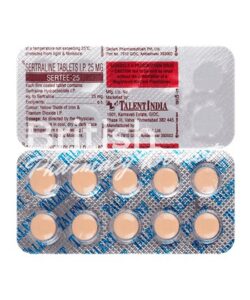
Sertraline is available on this page at 25, 50 and 100 mg, and each strength comes in quantities of 30, 60, 90, 120, 180, 270 or 360 tablets, so a prescribed daily dose can be made up from one strength or a mix of two. The 25 mg tablet matches the SmPC starting dose for panic disorder, social anxiety, PTSD and OCD in children aged 6 to 12.
Dose steps from the first week onwards
Depression and OCD are both started on 50 mg, given once daily. A gentler start suits panic disorder, social anxiety and PTSD: 25 mg a day for seven days, then 50 mg. Any further increase is made in 50 mg steps no more often than once a week, up to 200 mg a day at most. In OCD, children aged 6 to 12 start with 25 mg and go to 50 mg after a week, while those aged 13 to 17 start at 50 mg. The daily tablet may be swallowed at breakfast time or in the evening, and meals make no difference. A response may begin within seven days, though the full benefit usually takes longer, and depression is treated for at least six months on the lowest effective dose. With liver impairment the dose is lowered or given less often, and severe liver disease rules it out; reduced kidney function needs no change.
Who should take care
Sertraline is contraindicated with pimozide, and also with an irreversible MAOI: 14 days should pass after such an MAOI before treatment starts, and seven days after the last tablet before an MAOI begins. Serotonin syndrome may develop if it is combined with other drugs that boost serotonin, fentanyl being one example. Anticoagulants, aspirin and NSAIDs add to the risk of bleeding. Caution is advised in epilepsy, a history of mania, QT prolongation and in older people, who are more likely to develop low sodium. Adults under 25 need close monitoring for suicidal thoughts early on, and anyone who becomes agitated, restless or low after starting should contact their prescriber quickly. Drinking alcohol during treatment is not recommended.
Side effects and stopping safely
Very common effects, seen in more than one person in ten, are nausea, diarrhoea, insomnia, headache, dizziness, sleepiness, dry mouth, fatigue and failure to ejaculate. Common ones include yawning, sweating, tremor, indigestion, palpitations, hot flushes, appetite and weight changes and visual disturbance, and many settle with time. Treatment should be tapered over at least one to two weeks, because stopping suddenly can cause dizziness, sensory disturbances, poor sleep and anxiety. Whether sertraline suits a given patient is for the doctor or prescriber to judge.