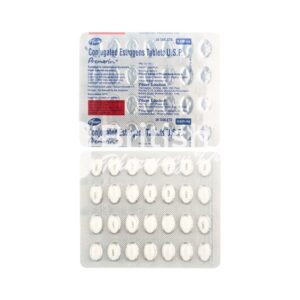
Premarin
In brief
- In our pharmacy, you can buy Premarin without a prescription, with delivery in 5–14 days throughout the United Kingdom. Discreet and anonymous packaging.
- Premarin (conjugated oestrogens) is used for hormone replacement therapy to relieve vasomotor and urogenital menopausal symptoms, for prevention of postmenopausal osteoporosis, treatment of hypoestrogenism and as palliative therapy in certain cancers; it contains a mixture of conjugated oestrogens that bind oestrogen receptors and alter gene transcription to restore oestrogenic effects.
- The usual dose is 0.3–1.25 mg once daily, with common starting doses of 0.3 mg or 0.625 mg; 0.625 mg daily is frequently used for osteoporosis prevention and many menopausal indications.
- Administered orally as tablets (available in 0.3 mg, 0.625 mg, 0.9 mg and 1.25 mg strengths) and occasionally by intravenous injection for short-term hospital use.
- Onset of symptom relief may begin within a few days, is often noticeable within 1–2 weeks, with maximal benefit commonly seen after 4–6 weeks of treatment.
- Duration of action is maintained with once-daily dosing (single-dose effects persist roughly 24 hours); long-term continuous or cyclic therapy is used depending on clinical indication and review.
- Alcohol warning: avoid excessive alcohol intake — heavy drinking may increase liver strain, worsen side effects and raise the risk of thromboembolic events; limit alcohol while taking Premarin.
- The most common side effect is headache.
- Would you like to try “premarin” without a prescription?
Basic Premarin Information
- INN (International Nonproprietary Name): Conjugated estrogens.
- Brand Names Available In United Kingdom: Premarin (Pfizer) — tablets 0.3 mg, 0.625 mg and 1.25 mg in boxes of 28.
- ATC Code: G03CA57.
- Forms & Dosages: Tablets 0.3 mg; 0.625 mg; 0.9 mg (select markets); 1.25 mg; injection for short-term hospital use (IV, various).
- Manufacturers In United Kingdom: Global manufacturer Pfizer; local supply via Pfizer affiliates and national distributors.
- Registration Status In United Kingdom: Prescription-only medicine registered for systemic estrogen use.
- OTC / Rx Classification: Prescription-only medicine (POM) under MHRA regulation.
Critical Warnings & Restrictions
Immediate Safety Priorities For UK Patients
Before starting Premarin check for pregnancy and breastfeeding due to absolute contraindications.
Confirm there is no known or suspected oestrogen-dependent cancer such as breast or endometrial carcinoma.
Screen for active or past venous thromboembolism, recent stroke or myocardial infarction and severe liver disease.
Premarin is conjugated estrogens (INN conjugated estrogens) with ATC G03CA57 and is prescription-only in the United Kingdom.
Prescribers must obtain informed consent that systemic oestrogen therapy increases risks of thromboembolism, stroke and breast cancer.
Pharmacists should counsel on red-flag symptoms and record allergies and concurrent anticoagulant or enzyme-inducing medicines on the patient record.
- Checklist At Initiation: pregnancy test if applicable; VTE/stroke/MI history; current liver function status; breast/endometrial cancer history; current anticoagulant use.
High-Risk Groups (Elderly, Pregnancy, Chronic Illness)
Absolute contraindications include pregnancy and breastfeeding, active or history of DVT/PE, stroke or myocardial infarction, and known or suspected oestrogen-dependent neoplasia.
Severe hepatic dysfunction is an absolute contraindication and Premarin should be avoided in that setting.
Elderly patients should be given the lowest effective dose and monitored closely for venous thromboembolism and cerebrovascular events.
Use caution in renal impairment and moderate hepatic disease and liaise with secondary care if dose adjustment or specialist input is required.
- Absolute Contraindications: undiagnosed vaginal bleeding; breast/uterine/estrogen-dependent neoplasia; active/history of DVT, PE, stroke, MI; severe liver dysfunction; pregnancy/breastfeeding.
- Relative Contraindications: chronic hypertension; diabetes mellitus; hereditary angioedema; moderate liver or kidney impairment; factors increasing VTE risk such as obesity or smoking.
Interaction With Activities & Legal Safety
Driving, Workplace Safety And UK Legal Considerations
Many people tolerate systemic conjugated oestrogens without impairment to psychomotor skills.
Common side effects such as dizziness, nausea or transient visual disturbance may affect driving or operating machinery.
Advise patients they must not drive if unfit and should avoid driving until they know how Premarin affects them.
Employers only need to be informed where workplace safety is affected by symptoms attributable to treatment.
Reporting And MHRA Yellow Card
Encourage reporting of suspected adverse reactions to the MHRA Yellow Card scheme by patients and healthcare professionals.
Pharmacies should supply the patient information leaflet and counsel on tasks requiring alertness following initiation or dose change.
- Before Driving/Work Checklist: do you feel dizzy, drowsy or have blurred vision; test at home first; avoid important journeys until symptom-free.
- Legal Duties And Reporting Pathways: drivers must ensure fitness to drive; pharmacists may report via Yellow Card; GPs handle prescribing and serious adverse event escalation.
Usage Basics
INN, Brand Names Available In The UK And Classification
Premarin’s INN is conjugated estrogens, sometimes described as conjugated equine oestrogens in lay terms.
In the UK Premarin (Pfizer) is available as oral tablets in 0.3 mg, 0.625 mg and 1.25 mg strengths.
Premarin is classified as systemic oestrogen therapy and is prescription-only medicine (POM) under MHRA rules.
Legal Classification And Counselling
As a POM pharmacists should confirm the indication, record baseline symptoms and provide written HRT safety information per NHS guidance.
Keep prescribing notes and medication reconciliation in the patient medication record and check for potential drug interactions at each dispensing.
Advice should cover symptom expectations, potential side effects such as breast tenderness and vaginal spotting, and when to seek urgent review.
Q&A — Can I Drive After Taking It In The UK?
Short answer: usually yes, unless you experience dizziness, drowsiness or visual changes after the dose.
If you are affected do not drive and consult your pharmacist or GP.
Persistent symptoms should be reported and documented if they affect fitness to drive for work or insurance purposes.
Dosing Guide
Standard Regimens (NHS-Aligned)
For menopausal symptoms standard adult dosing ranges from 0.3 mg to 1.25 mg daily, with typical starts at 0.3 mg or 0.625 mg daily.
For prevention of postmenopausal osteoporosis a common dose used is 0.625 mg daily where HRT is appropriate.
Regimens can be continuous daily or cyclic such as three weeks on and one week off, depending on symptoms and whether a progestogen is also required.
Start at the lowest effective dose and review therapy at around three months and then at least annually.
Adjustments For Comorbidities
In elderly patients use the lowest effective dose and monitor for signs of venous thromboembolism and stroke.
Renal impairment requires caution and possible dose adjustment, while severe hepatic impairment is a contraindication to use.
Higher doses for palliative oncology indications are specialist-led and titrated according to clinical response and tolerability.
Q&A — What If I Miss A Dose?
Take the missed dose as soon as you remember unless it is almost time for the next dose, in which case skip the missed dose.
Do not double up on doses to make up for missed tablets.
If multiple doses are missed, or in the event of an overdose with nausea, vomiting or unexpected bleeding, seek GP or urgent care advice.
- Missed-Dose Steps: take when remembered; skip if next dose is due soon; contact GP if doses missed repeatedly.
- Definitions: continuous therapy is daily dosing without break; cyclic therapy includes planned drug-free intervals to induce withdrawal bleeding.
Interaction Chart
Food, Drink And Lifestyle Interactions
Alcohol does not have a direct pharmacokinetic interaction with conjugated oestrogens but it increases overall cardiovascular risk and should be moderated.
Smoking increases the risk of venous thromboembolism and alters the clinical risk–benefit profile of systemic oestrogen therapy.
Caffeine has no major interaction with Premarin but can exacerbate palpitations or anxiety that some patients experience on HRT.
Common Drug Conflicts And MHRA Yellow Card Signals
Conjugated oestrogens can have reduced efficacy when co-administered with hepatic enzyme inducers such as certain anticonvulsants, rifampicin and St John’s Wort.
Oestrogen therapy can interact with anticoagulants and may alter INR control, so monitoring is required when used together.
| Interacting Agent | Effect | Clinical Action |
|---|---|---|
| Anticonvulsants (eg carbamazepine) | May reduce oestrogen levels | Consider alternative therapy or specialist advice; monitor symptoms. |
| Rifampicin | Induces metabolism and reduces efficacy | Avoid combination if possible; liaise with prescriber. |
| St John’s Wort | May decrease systemic oestrogen effect | Advise cessation and check interactions. |
| Warfarin | May alter INR | Monitor INR more frequently when starting or stopping Premarin. |
Conduct medication reconciliation at every dispensing and flag interactions on the PMR.
User Reports & Trends
Patient-Reported Outcomes On UK Forums And NHS Resources
Many patients on NHS Choices and Patient.info report effective relief of hot flushes and improvement in urogenital dryness with Premarin and other oestrogen therapies.
Concerns about long-term breast cancer and venous thromboembolism risks are common and drive some patients to seek non-hormonal alternatives.
Experiences vary with dose and formulation, and common side effects described include breast tenderness, mood changes and irregular spotting.
Interpreting Anecdotal Data
Positive Experiences: rapid reduction in vasomotor symptoms, improved sleep and vaginal symptoms with topical or systemic oestrogen preparations.
Negative Experiences: anxiety about cancer risk, VTE concern, breakthrough bleeding and mood or weight changes.
Clinicians should treat anecdote as hypothesis-generating and balance individual reports against randomised trials and epidemiological data.
| Forum Sentiment | Published Safety Data |
|---|---|
| Mostly positive for symptom relief | RCTs support efficacy at 0.3–0.625 mg for vasomotor symptoms with dose-dependent risks |
| High concern about long-term risks | Observational data show increased VTE and possible breast cancer signal with systemic oestrogens |
Access & Purchase Options In The UK
High-Street Pharmacies And Chains
Premarin is prescription-only and dispensed by major chains such as Boots, LloydsPharmacy and independent community pharmacies when a valid prescription is provided.
Community pharmacists provide counselling at point of supply and can authorise repeat supplies where locally agreed.
Online Pharmacies And NHS E-Prescriptions
Legitimate online pharmacies and the NHS Electronic Prescription Service (EPS) are increasingly used for convenience and repeat prescriptions.
Patients should verify GPhC registration and avoid overseas sellers when purchasing online.
- How To Obtain Safely: get a valid prescription from GP or clinic; use MHRA-registered and GPhC-verified online pharmacies; check packaging and batch information on receipt.
In our online pharmacy, premarin is available without a prescription, with discreet delivery to United Kingdom in 5-14 days.
| Route | Typical Private Price | NHS Availability |
|---|---|---|
| GP/NHS | Not applicable | Prescribable where indicated; local formulary applies |
| Private Clinic | Variable (private consultation + drug cost) | Private prescription supplied via pharmacy |
| Online Pharmacy | Variable; check verified seller | EPS supported where prescription issued electronically |
Mechanism & Pharmacology
Simplified Explanation For Patients
Conjugated oestrogens are a mixture of oestrogenic compounds derived from equine sources that bind oestrogen receptors in target tissues.
Systemic oestrogen restores oestrogen-deficient physiology to relieve hot flushes, night sweats and urogenital dryness and to help maintain bone density.
Patients usually notice vasomotor symptom improvement within weeks and maximal benefit over a few months.
Clinical Terms For Prescribers
ATC G03CA57 denotes systemic conjugated natural oestrogens.
Oral bioavailability is affected by first-pass hepatic metabolism and this influences dose selection and side-effect profile.
- Definitions: INN — International Nonproprietary Name.
- Definitions: ATC Code — anatomical therapeutic chemical classification.
- Definitions: First-Pass Effect — hepatic metabolism reducing active drug reaching systemic circulation.
Indications & Off-Label Uses
MHRA‑Approved Indications
Premarin is licensed for hormone replacement therapy to relieve menopausal vasomotor and urogenital symptoms.
It is also indicated for prevention of postmenopausal osteoporosis when alternative treatments are unsuitable.
Indications include hypoestrogenism due to ovarian failure and specialist palliative use in certain cancers.
Off‑Label Practices In NHS/Private Care
Occasional off‑label uses include other hypoestrogenic states under consultant supervision and specialist high-dose regimens for oncological palliation.
- Approved Uses: menopausal symptom relief; osteoporosis prevention; hypoestrogenism; specialist palliative care.
- Off‑Label Uses: bespoke regimens under specialist prescription only.
- Off‑Label Checklist: document rationale, obtain informed consent, record monitoring plan.
Key Clinical Findings
Major UK And EU Evidence (2022–2025)
Randomised trials and pooled data continue to show Premarin and other systemic oestrogens are effective at doses of 0.3–0.625 mg for vasomotor control.
Evidence indicates dose-dependent increases in venous thromboembolism and stroke risk with systemic oestrogen preparations.
Regulatory reviews maintain prescription-only status with emphasis on lowest effective dose for shortest duration consistent with treatment goals.
How Evidence Changes Practice
Shared decision-making is essential and clinicians must explain absolute versus relative risk and offer non-hormonal options where appropriate.
Minimise duration and use the lowest effective dose while monitoring blood pressure, symptoms and breast health.
| Benefit | Harm |
|---|---|
| Relief of hot flushes and urogenital symptoms; bone protection | Increased risk of VTE, stroke, and possible breast cancer signal (dose-dependent) |
Recommended references include current MHRA and EMA safety communications and product information.
Alternatives Matrix
NHS Prescribing Alternatives And Comparison
Alternatives to conjugated oestrogens on the NHS include estradiol preparations such as Estrace, Estrofem and Divigel, and estriol products like Ovestin for local vaginal symptoms.
Combined HRT options containing a progestogen are recommended for women with an intact uterus to reduce endometrial cancer risk.
| Drug | Route | Typical Dose | Pros | Cons |
|---|---|---|---|---|
| Estradiol (Estrace/Estrofem) | Oral/Transdermal | Varies (eg 1 mg oral; transdermal dosing by patch) | Well-studied; multiple formulations | Systemic risks similar to other oestrogens |
| Estriol (Ovestin) | Topical vaginal | Local dosing | Effective for vaginal atrophy with lower systemic exposure | Limited benefit for vasomotor symptoms |
| Combined HRT (eg Femoston) | Oral/Transdermal | Varies | Protects endometrium if uterus present | Progestogen side effects possible |
Pros And Cons Checklist
- Consider Symptom Profile: vasomotor versus urogenital priorities guide choice of systemic versus topical therapy.
- Consider Uterus Present: include progestogen for uterine protection if needed.
- Assess VTE Risk: prefer lowest effective systemic dose or topical options for higher-risk patients.
- Consider Cost And Availability: generic estradiol options may reduce private cost.
Common Questions
Three To Four FAQs Drawn From UK Consultations
How Long Should I Stay On HRT?
Duration is individualised; review after three months and then at least annually to assess symptoms and risks.
Should I Continue Breast Screening On HRT?
Yes; continue routine NHS screening and discuss any breast changes with GP and the screening programme if on HRT.
Do I Need Contraception After Starting HRT?
Contraceptive needs depend on age and residual ovarian function; discuss contraception with the prescriber if fertility remains a possibility.
Can I Switch Between Preparations?
Switching is common and should be managed with prescriber or pharmacist advice to maintain symptom control and safety monitoring.
Format And Delivery
Use micro-FAQ blocks and bullet lists for patient leaflets to aid quick reading and comprehension.
- Questions To Ask At Consultation: expected timeline, side effects, monitoring schedule, alternative treatments.
NHS Cost & Access Comparison Table
Regional Differences And Prescription Charging
Prescription charging varies across the UK; England typically applies a per-item charge unless exempt, while Scotland, Wales and Northern Ireland offer free prescriptions.
Premarin remains a prescription-only medicine and supply depends on local formularies and clinical commissioning policies.
Suggested Table Content
| Source | Typical Private Price | NHS Prescription Charge/Exemption Status | Pharmacy Chains Supplying |
|---|---|---|---|
| GP/NHS | Not applicable | Charge in England unless exempt; free in Scotland/Wales/Northern Ireland | Boots, LloydsPharmacy, independent pharmacies |
| Private | Variable by clinic and pharmacy | Private prescriptions charged to patient | All major chains and private clinics |
| Online | Variable; check verified sellers | Depends on prescription origin (private vs NHS) | GPhC-verified online pharmacies |
- Cost-Saving Options: consider generic estradiol alternatives, prescription pre-payment certificates, or checking exemption status.
Registration & Regulation
MHRA Approval, EMA Context And Manufacturer
Premarin is marketed by Pfizer and is registered in multiple jurisdictions including EMA member states and national agencies.
In the UK prescribing and safety monitoring are overseen by the MHRA and adverse events should be reported via the Yellow Card scheme.
Prescribing Framework And Formularies
NHS formulary status may vary regionally and GPs should follow local guidelines for HRT initiation, monitoring and switching.
- Definitions: MHRA — Medicines and Healthcare products Regulatory Agency.
- Definitions: EMA — European Medicines Agency.
- Definitions: GPhC — General Pharmaceutical Council; EPS — Electronic Prescription Service.
| Regulatory Step | Action |
|---|---|
| Approval | National agency authorises marketing as POM. |
| Labelling | Product information reflects indications, dosing and contraindications. |
| Post-Marketing Surveillance | Yellow Card reporting and periodic safety updates. |
Storage, Handling & Guidelines For Proper Use
UK Household Storage And Pharmacist Counselling
Store Premarin at room temperature between 15 °C and 30 °C and protect from moisture and light in the original packaging.
Advise patients in UK homes with damp bathrooms to keep tablets in a sealed container in a cupboard away from heat and humidity.
Pharmacists should provide concise counselling covering dose timing, missed-dose action, disposal and when to seek urgent medical help.
Practical Patient-Safety Checklist
- Read the patient information leaflet supplied with the medication.
- Attend review appointments at three months and then annually or as advised.
- Report side effects via the MHRA Yellow Card scheme or to the prescriber.
- Do not stop abruptly without consulting your GP or pharmacist.
- Disposal: return unused tablets to a pharmacy for safe disposal.
- Monitoring Checklist: blood pressure checks, mammography as per screening schedule, symptom review and VTE risk reassessment.
Delivery Across United Kingdom
| City | Region | Delivery Time |
|---|---|---|
| London | England | 5-7 days |
| Birmingham | England | 5-7 days |
| Manchester | England | 5-7 days |
| Glasgow | Scotland | 5-7 days |
| Leeds | England | 5-7 days |
| Edinburgh | Scotland | 5-7 days |
| Bristol | England | 5-7 days |
| Liverpool | England | 5-9 days |
| Newcastle Upon Tyne | England | 5-9 days |
| Nottingham | England | 5-9 days |
| Southampton | England | 5-9 days |
| Belfast | Northern Ireland | 5-9 days |
| Cardiff | Wales | 5-9 days |
| Leicester | England | 5-9 days |