Erythromycin
In brief
- In our pharmacy, erythromycin can be purchased without a prescription, with delivery available throughout the United Kingdom in discreet packaging. In many other countries it is prescription-only (Rx), so local rules may differ.
- Erythromycin is used to treat bacterial infections such as respiratory, skin and soft-tissue infections, acne, and certain eye infections. It works by inhibiting bacterial protein synthesis by binding to the 50S ribosomal subunit; it is a macrolide antibiotic.
- The usual dose depends on the condition and formulation. For adults, oral doses are commonly 250–500 mg every 6 hours; for children, 30–50 mg/kg/day in 2–4 divided doses. Topical acne treatment is usually 2% applied twice daily, and eye ointment is typically used every 6 hours as directed.
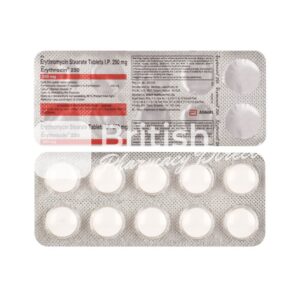
- Erythromycin is available as oral tablets, delayed-release tablets, oral suspensions, topical solution or gel, eye ointment, and powder for suspension.
- The effect usually begins within 1–2 hours after an oral dose, though symptom improvement for infections may take longer; topical and ophthalmic preparations may start working locally sooner.
- The duration of action is typically around 6 hours for standard oral dosing, which is why it is often taken four times daily. Treatment courses for infections are usually 7–14 days, depending on the condition.
- Avoid or limit alcohol while taking erythromycin, as it can increase stomach irritation and may worsen nausea or diarrhoea.
- The most common side effects are nausea, vomiting, abdominal cramps, and diarrhoea. Some people may also experience rash, local irritation, or taste disturbances.
- Would you like to try erythromycin without a prescription?
Basic Erythromycin Information
- INN (International Nonproprietary Name): Erythromycin
- Brand names available in United Kingdom: Erythromycin is often supplied generically in the UK; international brand examples include Erythrocin, Erythroped, Erymax, Tiloryth, Primacine, Aknemycin Plus, Ilosone, E.E.S. 400, Akne-Mycin, Macin, Mitrocin, Makcin, Mycin, and Ery.
- ATC Code: J01FA01
- Forms & dosages: Oral tablets 250 mg, 500 mg, 400 mg; oral suspensions 125 mg/5 ml and 250 mg/5 ml; delayed-release tablets 250 mg and 400 mg; topical solution/gel 2%; eye ointment 5 mg/g; powder for suspension 125 or 250 mg/5 ml.
- Manufacturers in United Kingdom: Erythromycin is supplied worldwide by manufacturers such as Alembic Pharmaceuticals, Polfa Tarchomin, Anuh Pharma Ltd, Anhui Sinotech, Tenatra, DKSH, Millat Pharmaceuticals, Hallmark Pharmaceuticals, and Azurity Pharmaceuticals.
- Registration status in United Kingdom: Systemic erythromycin is prescription-only in most jurisdictions, and in the UK it should be used under NHS or private prescribing guidance.
- OTC / Rx classification: Prescription only (Rx) in most jurisdictions; over-the-counter use is not available for systemic forms in most countries.
Safety First: Who Should Not Take Erythromycin And When To Seek Urgent Help
Worried about whether erythromycin is suitable for you or someone in your family?
That is the right place to start, because safety comes before convenience every time.
Do not take erythromycin if you have a known macrolide allergy, including allergy to erythromycin itself.
It must also be avoided if you previously developed cholestatic jaundice or hepatic dysfunction linked to erythromycin.
Another hard stop is taking medicines that significantly prolong the QT interval or are contraindicated because of CYP3A4 interactions.
If there is any doubt about your regular medicines, a pharmacist should check them before supply.
People at higher risk need extra caution, especially older adults, anyone with liver disease, heart rhythm problems, myasthenia gravis, or pregnant and breastfeeding patients who should only use it on clinician advice.
- Palpitations, fainting, severe rash, breathing difficulty, jaundice, or severe diarrhoea need urgent medical review.
- If symptoms start soon after the first dose, stop the medicine and seek help promptly.
- If you feel unwell after combining erythromycin with another prescription or OTC medicine, ask for an immediate medicines check.
In the UK, erythromycin is prescription-only, so it should be used under NHS or private prescribing guidance and not self-started for suspected infection.
What Erythromycin Is And How UK Patients May See It Prescribed
Asked what erythromycin actually is and why a GP might choose it?
Erythromycin is a macrolide antibiotic used for bacterial infections and some other clinician-directed uses.
Its ATC code is J01FA01, which simply places it in the antibacterials for systemic use group, within the macrolides class.
UK patients may see erythromycin tablets, erythromycin oral suspension, erythromycin topical treatment, or erythromycin ointment depending on the problem being treated.
- INN: Erythromycin.
- ATC code: J01FA01.
- Macrolide: A type of antibiotic with a similar bacterial target to azithromycin and clarithromycin.
Brand names vary by country, so a patient may recognise names such as Erythrocin, Erythroped, Erymax, Tiloryth, Primacine, or Aknemycin Plus even when the UK pack is supplied generically.
UK Availability, Prescription Rules, And Where Patients Usually Obtain It
Trying to work out how to get erythromycin in the UK?
Systemic erythromycin is prescription-only, so the usual route is through a GP, urgent care service, or specialist who issues an NHS or private prescription.
Community pharmacies, including Boots, LloydsPharmacy, and Superdrug, commonly dispense it, while online pharmacies can also supply it when a valid prescription has been verified.
Pharmacists often take the lead on counselling in the UK, especially when a patient is unsure about timing, interactions, or side effects.
Regulatory oversight sits with the MHRA, which helps keep medicines safety under review across the UK market.
- NHS prescription supply for eligible patients.
- Private prescription supply when appropriate.
- Online pharmacy dispensing with prescription verification.
- Electronic prescriptions, which are increasingly common in UK practice.
For some people, an online order is simply about convenience, and discreet delivery to the United Kingdom in 5-14 days can be available through our online pharmacy once the medicine has been prescribed or verified where applicable.
What Erythromycin Is Used For In Practice
Wondering whether erythromycin is for a chest infection, acne, or an eye problem?
The answer depends on the formulation and the diagnosis.
It is used for respiratory infections, skin and soft-tissue infections, acne vulgaris when used topically, and ophthalmic infections such as bacterial conjunctivitis when supplied as eye ointment.
Clinician-led use may also include pharyngitis, bronchitis, sinusitis, skin infections, and certain other bacterial problems.
Not every sore throat, cough, or rash needs an antibiotic, so the diagnosis matters as much as the drug name.
| Condition | Usual Formulation | Typical Duration |
|---|---|---|
| Respiratory infection | Oral tablets or suspension | 7–14 days |
| Skin or soft-tissue infection | Oral tablets or suspension | 7–10 days |
| Acne vulgaris | 2% topical solution or gel | Until improvement |
| Bacterial conjunctivitis | Eye ointment | 7–14 days |
In practice, erythromycin 250 mg uses and erythromycin 500 mg uses are most often discussed for respiratory or skin infections, while the topical form is better known for erythromycin for acne.
How Erythromycin Works In The Body
Patients often ask how an antibiotic can help if they do not feel very ill at first.
Erythromycin is a macrolide that stops bacteria from making proteins, so the organisms cannot grow and multiply effectively.
That action makes it useful against some respiratory and skin pathogens, and it is one reason the erythromycin antibiotic class remains clinically relevant.
- Macrolide
- An antibiotic group that includes erythromycin, azithromycin, and clarithromycin.
- Protein synthesis
- The bacterial process erythromycin blocks.
- Antibacterial effect
- The result of stopping bacterial growth.
Dosing Basics For Adults And Children
How much should a patient actually take?
The dose depends on the infection, the age of the patient, and the formulation being used.
Adults are commonly prescribed 250–500 mg every 6 hours by mouth for respiratory or skin infections.
Children usually need suspension and weight-based dosing at 30–50 mg/kg/day in 2–4 doses.
For acne, the topical 2% solution or gel is usually applied twice daily.
For eye infection, eye ointment is typically applied every 6 hours in the affected eye or eyes where prescribed.
| Use | Adult Dose | Child Dose |
|---|---|---|
| Respiratory infection | 250–500 mg every 6 hours orally | 30–50 mg/kg/day in 2–4 doses |
| Skin or soft-tissue infection | 250–500 mg every 6 hours orally | 30–50 mg/kg/day in 2–4 doses |
| Acne | 2% solution or gel twice daily | Not typically used |
| Eye infection | Eye ointment every 6 hours | Safety in under 2 months not established |
- Suspension is often chosen for children because dosing is easier to match to weight.
- Delayed-release tablets may be used when a prescriber wants a different absorption profile.
- Always follow the label or prescription rather than guessing from the pack strength.
Dose Adjustments, Missed Doses, And Overdose Precautions
What happens if the dose is missed, or if the patient has liver or kidney problems?
Children need weight-based dosing, and suspensions are usually the safest way to deliver it accurately.
Older adults do not usually need a routine dose change, but monitoring for hepatic function is sensible.
Liver impairment may require dose reduction or longer intervals because erythromycin is metabolised in the liver.
Renal impairment usually does not require adjustment unless it is severe, although close monitoring is still sensible.
- Take a missed dose as soon as remembered unless the next dose is nearly due.
- Do not double up to make up for a missed dose.
- Seek medical help immediately if a large amount has been taken.
- Overdose symptoms can include marked gastrointestinal upset and possible ototoxicity at high doses.
What If I Miss A Dose?
Take it as soon as you remember, unless your next dose is due soon.
If that happens, skip the missed dose and carry on.
Never take two doses at once.
Side Effects UK Patients Should Know About
Is this one of those antibiotics that always upsets the stomach?
It can cause gastrointestinal effects, and those are the side effects most people notice first.
Common problems include nausea, vomiting, abdominal cramps, and diarrhoea.
Rash and local irritation can occur with topical and oral forms.
Taste disturbance is also reported, and transient hearing problems may occur, particularly at higher IV or oral doses.
Severe diarrhoea, blood in the stools, or signs of an allergic reaction need urgent assessment.
- Common: nausea, vomiting, abdominal cramps, diarrhoea, rash, taste disturbance.
- Less common but important: transient hearing loss, especially at higher doses.
- Urgent: severe diarrhoea, blood in stools, swelling, wheeze, or widespread rash.
Drug Interactions And Food Or Drink Issues
Why do pharmacists always ask for a full medicines list with erythromycin?
Because interactions matter here, both through CYP3A4 metabolism and QT prolongation risk.
That means some heart medicines, certain antifungals, some statins, and any medicine that affects heart rhythm need careful checking before supply.
It is also essential to mention all prescription medicines, over-the-counter products, and herbal remedies, because even a short course can cause trouble when combined with the wrong treatment.
Food may affect tolerability depending on the formulation, so some patients find it easier to take the dose with food if their prescriber or pharmacist agrees.
Alcohol is not usually a direct interaction, but it may worsen stomach upset, which is already a common issue with erythromycin.
| Interaction Type | Examples | Action |
|---|---|---|
| QT prolongation | Medicines that lengthen the QT interval | Avoid or review urgently |
| CYP3A4 interaction | Medicines extensively metabolised by CYP3A4 | Check before use |
| Heart medicines | Selected antiarrhythmics and related drugs | Medicines review required |
| Statins and antifungals | Some members of these classes | Pharmacist or prescriber check needed |
- Tell the pharmacist about every prescription and non-prescription medicine.
- Mention any herbal remedy, even if it seems harmless.
- Ask before starting a new medicine while taking erythromycin.
Who Needs Extra Caution: Pregnancy, Breastfeeding, Myasthenia Gravis, And Older Age
Some patients need a higher level of review before starting this antibiotic.
Pregnancy and breastfeeding are situations where a clinician weighs the benefits and risks carefully.
Myasthenia gravis may worsen, so that history should always be mentioned before any prescription is issued.
Arrhythmias or prolonged QT need careful review because erythromycin can increase rhythm risk.
Older adults and people with chronic illness may be more vulnerable to side effects and medicine interactions.
- Pregnancy.
- Breastfeeding.
- Myasthenia gravis.
- Arrhythmia or prolonged QT interval.
- Older age or chronic liver disease.
Can I Drive After Taking It In The UK?
If you feel dizzy, unwell, or have visual or hearing changes, do not drive.
If the medicine affects you, follow UK driving safety advice and seek pharmacist or prescriber guidance.
UK Prescribing, NHS Expectations, And Counselling From Pharmacists
Wondering what usually happens from prescription to collection?
In the UK, erythromycin is usually prescribed by a GP, urgent care clinician, or specialist, then dispensed by a community or online pharmacy.
Electronic prescriptions are increasingly common, which makes collection easier for many patients.
Pharmacy teams often check suitability, explain the dose, and help choose an alternative if stock is limited.
That counselling role matters because erythromycin tablets, erythromycin oral suspension, and erythromycin ointment all have slightly different instructions.
- What symptom is being treated.
- Which medicines are already being taken.
- Any history of allergy, liver disease, or heart rhythm problems.
- Whether the patient needs tablets, suspension, topical treatment, or eye ointment.
Cost, Prescription Charges, And Regional Differences Across The UK
How much does erythromycin cost in practice?
That depends on where the prescription is issued, whether the patient is exempt, and whether the medicine is supplied through NHS or private routes.
In England, prescription charges apply unless the patient is exempt.
Scotland, Wales, and Northern Ireland generally provide NHS prescriptions free at the point of use.
Private and online pharmacy prices can vary depending on the formulation and quantity supplied.
| UK Nation | Usual NHS Charging Position |
|---|---|
| England | Charges apply unless exempt |
| Scotland | Free at the point of use |
| Wales | Free at the point of use |
| Northern Ireland | Free at the point of use |
Boots, LloydsPharmacy, and Superdrug are common access points, but stock and brand can differ from one branch to another.
| Supply Route | What Affects The Price |
|---|---|
| NHS | Prescription status and exemption rules |
| Private | Product choice and consultation fees |
| Online | Formulation, quantity, and delivery service |
Storage, Transport, And Handling In The Home
Where should erythromycin be kept once it is dispensed?
Tablets and capsules should be stored below 25°C and protected from moisture.
Suspensions should be handled according to the label, and if reconstituted they may need refrigeration; shaking before use is important.
Topical products should be kept at room temperature and not frozen.
Eye ointment should be stored below 25°C and discarded after the course ends.
- Avoid damp bathrooms and hot radiators.
- Keep liquid medicine out of direct sunlight during travel.
- Do not freeze topical products.
- Check the label before storing a reconstituted suspension in the fridge.
Brand Names, Formulations, And Alternatives Patients May Hear About
Seeing a different name on the box can be confusing, especially when the pharmacy supplies a generic pack.
International brand examples include Ilosone, E.E.S. 400, Akne-Mycin, Ery, Erythrocin, Erythroped, Erymax, Tiloryth, Primacine, and Aknemycin Plus.
The most common formulations are oral tablets, delayed-release tablets, oral suspension, topical solution or gel, and eye ointment.
Some patients may hear about azithromycin or clarithromycin, which are also macrolide antibiotics and may be preferred for some infections because of shorter treatment durations or better tolerability.
| Brand Example | Typical Form |
|---|---|
| Ilosone | Tablets or suspension |
| E.E.S. 400 | Tablet |
| Akne-Mycin | Topical ointment |
| Ery | Eye ointment |
Questions UK Patients Often Ask Before Starting Erythromycin
How Long Does Treatment Usually Last?
Most infections are treated for 7–14 days, while skin infections are often 7–10 days.
Acne treatment can last several weeks if the prescriber advises ongoing use.
Can Erythromycin Treat Acne?
Yes, the topical 2% solution or gel is used for acne vulgaris and some skin infections.
The oral form is generally used for infection, not for routine acne self-treatment.
What Should I Do If Side Effects Start?
Mild stomach upset may settle, but persistent vomiting, severe diarrhoea, rash, or breathing problems need prompt assessment.
If symptoms feel serious, contact a pharmacist, NHS 111, a GP, or urgent care.
Are The Topical And Oral Forms Interchangeable?
No, they are not interchangeable.
Topical treatment works locally, while oral treatment acts throughout the body and carries more interaction risk.
- Contact help if you develop jaundice, fainting, palpitations, or severe rash.
- Contact help if diarrhoea is severe or contains blood.
- Contact help if you are unsure whether the product is for acne, an eye infection, or a systemic infection.
Delivery Across United Kingdom
| City | Region | Delivery time |
|---|---|---|
| London | Greater London | 5-7 days |
| Birmingham | West Midlands | 5-7 days |
| Manchester | North West England | 5-7 days |
| Glasgow | Scotland | 5-7 days |
| Edinburgh | Scotland | 5-7 days |
| Liverpool | North West England | 5-7 days |
| Leeds | Yorkshire and the Humber | 5-7 days |
| Newcastle upon Tyne | North East England | 5-7 days |
| Bristol | South West England | 5-7 days |
| Cardiff | Wales | 5-7 days |
| Nottingham | East Midlands | 5-9 days |
| Sheffield | South Yorkshire | 5-9 days |
| Leicester | East Midlands | 5-9 days |
| Aberdeen | Scotland | 5-9 days |
| Norwich | East of England | 5-9 days |
Final Points To Remember Before Starting Erythromycin
Erythromycin is a useful macrolide antibiotic, but it needs the right diagnosis, the right dose, and the right medicines check.
It is prescription-only in the UK, and it should be used under NHS or private prescribing guidance.
If you have liver disease, rhythm problems, myasthenia gravis, or a previous macrolide allergy, speak to a pharmacist or prescriber before taking it.
If you are unsure whether your symptoms need erythromycin tablets, erythromycin oral suspension, or erythromycin ointment, the safest next step is a proper medicines review.