Timoptic
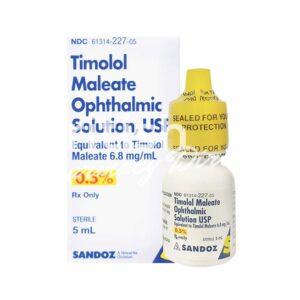
In stock
0.5%
from 24,46 £
In brief
- Timoptic is a 0.5% timolol maleate eye drop that lowers the pressure inside the eye, supplied here as an imported product.
- Available as 0.5% only, in boxes containing 2, 4 or 6 bottles.
- Timolol eye drops are POMs in the UK, where they are sold as Timoptol and generics, not as Timoptic.
About Timoptic eye drops
Timoptic is a solution of timolol maleate at 0.5%, which provides 5 mg of timolol in every millilitre. Its active ingredient is a non-selective beta-blocker. Once dropped into the eye, timolol reduces the production of aqueous humour, the clear fluid in the front of the eye, so the pressure inside the eye falls. Lower pressure helps protect the optic nerve, which raised pressure can damage gradually without symptoms until side vision is affected. The bottles offered here are imported.
Eye conditions in the UK licence
UK timolol eye drops are licensed for ocular hypertension, chronic open-angle glaucoma, aphakic glaucoma (glaucoma in an eye whose natural lens has been removed with no implant fitted) and some forms of secondary glaucoma. Eye pressure is measured regularly during treatment, and the optic nerve and visual field are usually checked over time. Glaucoma generally needs long-term treatment, because the pressure goes up again once the drops are stopped.
Pack options
Timoptic is available only as 0.5%, in packs of 2, 4 or 6 bottles. According to the UK SmPC, an opened bottle should be thrown away after 28 days even if some solution remains, so it helps to write the opening date on the carton.
How the drops are used
The UK SmPC begins treatment with one drop of 0.25% solution in each affected eye twice a day and moves to 0.5%, also twice daily, if pressure is not controlled. The pressure is checked again after about four weeks, and when it is stable once-daily use may be enough. After each drop, closing the eye and pressing gently on the inner corner for two minutes keeps more medicine in the eye and reduces the amount absorbed into the body. To keep the solution sterile, avoid letting the dropper tip come into contact with the eye, eyelashes or fingers. Soft contact lenses are removed before use and left out for at least 15 minutes, as they can absorb the preservative. Combining two beta-blocking eye drops is not recommended.
Legal category and the names used in Britain
In Britain, timolol drops of any brand require a prescription (POM). The UK range includes Timoptol, the gel-forming Timoptol LA, generic solutions and fixed combinations with other glaucoma treatments, but no product is licensed under the Timoptic name. Whether to use Timoptic is a decision for the prescriber.
Who should avoid timolol drops
Some of the timolol is absorbed into the bloodstream, so the drops carry similar restrictions to beta-blocker tablets. They are contraindicated in asthma or a history of asthma, severe chronic obstructive pulmonary disease, sinus bradycardia, sick sinus syndrome, sino-atrial block, second- or third-degree AV block not controlled by a pacemaker, overt heart failure and cardiogenic shock. Caution is needed in coronary heart disease, low blood pressure, circulation problems such as Raynaud’s phenomenon, milder lung disease, diabetes, where signs of a hypo may be hidden, and an overactive thyroid, whose symptoms may be masked. Using the drops alongside oral beta-blockers, calcium channel blockers, digoxin or anti-arrhythmics can slow the heart further, and quinidine, fluoxetine or paroxetine may raise timolol levels. Timolol should be used during pregnancy only if clearly needed, and it is also excreted in breast milk.
Unwanted effects to watch for
The eye may sting, burn, itch or redden, and vision can blur for a short time after a drop. Because some timolol is absorbed, a slow heart rate, dizziness, tiredness, wheezing and breathlessness can also occur. Anyone who becomes wheezy or notices a very slow pulse while using Timoptic should seek medical advice promptly.