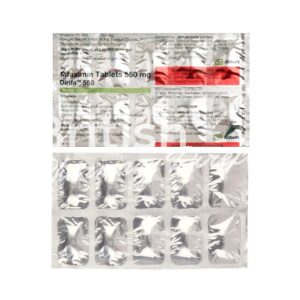
Rifaximin
In brief
- In our pharmacy, you can buy rifaximin without a prescription, with delivery in 9–21 days throughout the United Kingdom. Discreet and anonymous packaging.
- Rifaximin is used to treat traveller’s diarrhoea, to reduce recurrence of hepatic encephalopathy, and is used off‑label for IBS with diarrhoea and SIBO. It is a poorly absorbed rifamycin antibiotic that inhibits bacterial DNA‑dependent RNA polymerase, acting locally in the gut.
- Typical doses: traveller’s diarrhoea — 200 mg three times daily for 3 days; IBS‑D — 550 mg three times daily for 14 days; hepatic encephalopathy prevention — 550 mg twice daily. Dose and duration depend on the indication and clinical judgement.
- The form of administration is oral tablets (commonly 200 mg and 550 mg).
- Symptom relief often begins within 24–48 hours, though full clinical response may take 1–3 days.
- Duration of action depends on indication: a 3‑day course for traveller’s diarrhoea, 14 days for IBS‑D, and ongoing twice‑daily dosing for hepatic encephalopathy prevention; the drug remains largely within the gut and effects can persist for days to weeks after treatment.
- No strict prohibition on alcohol, but avoid excessive alcohol — especially if you have liver disease or are being treated for hepatic encephalopathy, since alcohol can worsen liver function.
- The most common side effects are nausea, abdominal pain, flatulence and headache; constipation and vomiting can also occur.
- Would you like to try rifaximin without a prescription?
Basic rifaximin information
- INN (international nonproprietary name): Rifaximin
- Brand names available in the United Kingdom: Targaxan (550 mg tablets), Xifaxanta (200 mg tablets)
- ATC code: A07AA11
- Forms and dosages: Film-coated tablets 200 mg and 550 mg
- Manufacturers in the United Kingdom: Norgine
- Registration status in the United Kingdom: Licensed by the MHRA; prescription-only medicine
- OTC / Rx classification: Prescription-only medicine (POM)
Critical warnings and restrictions — safety first (UK)
Who should be checked before prescribing?
Prioritise patient safety before any discussion of rifaximin efficacy.
Check hepatic function, pregnancy and breastfeeding status, allergy history and current immune competence.
Rifaximin is poorly absorbed but systemic hypersensitivity and C. difficile–associated disease can occur.
Avoid use in known rifamycin allergy.
Elderly patients and those with severe hepatic impairment or immunocompromise need specialist review.
Document the rationale for treatment and a clear monitoring plan in clinical notes.
High-risk groups (elderly, pregnancy, chronic illness)
High-risk groups need careful assessment before rifaximin is started.
Include elderly patients who have multiple comorbidities or significant polypharmacy.
Include patients with severe hepatic impairment where specialist hepatology advice is required.
Include pregnant or breastfeeding patients and arrange obstetric review before use.
Include immunocompromised patients and those with recent organ transplants or on high-dose immunosuppression.
Stop treatment and seek urgent review for jaundice, severe rash, or signs of C. difficile infection such as severe diarrhoea, abdominal pain or fever.
Review concomitant medicines such as warfarin and ciclosporin and record counselling in the clinical record.
Interaction with activities (driving, workplace safety under UK law)
Rifaximin does not typically impair cognition.
Dizziness or fatigue may rarely occur.
Advise patients not to drive or operate machinery until they know how the drug affects them.
Flag safety-critical roles and reference DVLA guidance where needed.
Q&A — “Can I drive after taking it in the UK?”
Usually yes, but avoid driving if you feel dizzy, drowsy or unwell.
Report restrictions to your employer if you work in a safety-critical role in line with DVLA guidance.
- Checklist for red flags: jaundice, severe rash, severe or worsening diarrhoea, fever, abdominal pain.
- High-risk groups: elderly with liver disease, pregnancy/breastfeeding, immunocompromised, severe hepatic impairment.
- Record counselling: document allergies, pregnancy check, driving advice, and interactions reviewed.
Usage basics
INN, brand names available in the UK
INN: rifaximin; UK brands are Targaxan (550 mg) and Xifaxanta (200 mg).
Common tablet strengths are 200 mg and 550 mg.
Check local NHS formulary entries and hospital stock lists for exact pack sizes and branded generics before supply.
Hospital pharmacies supply inpatient or outpatient starter packs according to trust policy.
Legal classification (POM, P, GSL)
Rifaximin is a prescription-only medicine (POM) in the UK and must normally be supplied against an NHS or private prescription.
Electronic prescriptions and NHS e-referrals are accepted by community and hospital pharmacies.
- Common strengths: 200 mg, 550 mg.
- Pharmacy counselling checklist: confirm indication, check pregnancy/breastfeeding, review interactions, advise on duration, provide patient leaflet.
| Brand | Typical pack sizes |
|---|---|
| Targaxan | 550 mg tablets — pack sizes vary by supplier |
| Xifaxanta | 200 mg tablets — check local stock lists for exact pack size |
In-pharmacy counselling points: verify indication, confirm allergy history, pregnancy check, explain dosing, explain signs of C. difficile to report immediately.
Dosing guide
Standard regimens (NHS guidance by indication)
Standard UK regimens differ by indication.
Travellers’ diarrhoea (non-invasive E. coli): 200 mg three times daily for three days.
IBS-D symptomatic relief (off-label in the UK): 550 mg three times daily for 14 days as a single course, with retreatment only after clinical review.
Hepatic encephalopathy prevention: 550 mg twice daily as adjunctive therapy to lactulose in selected patients.
Always follow the local NHS formulary and specialist hepatology or gastroenterology advice for initiation and repeat prescribing.
Adjustments for comorbidities
Dose reductions for renal impairment are generally not required owing to minimal systemic absorption.
Use caution in severe hepatic impairment and assess elderly patients for comorbidities and polypharmacy.
Pregnant or breastfeeding patients require specialist discussion prior to use.
Q&A — “What if I miss a dose?”
Take the missed dose when remembered unless it is close to the next scheduled dose.
Do not double up to make up for a missed dose.
Contact the prescriber or pharmacist if multiple doses are missed.
- Indication-specific regimens: travellers’ diarrhoea 200 mg TDS x 3 days; IBS-D 550 mg TDS x 14 days; hepatic encephalopathy 550 mg BD maintenance.
| Indication | Typical dosing |
|---|---|
| Travellers’ diarrhoea (non-invasive) | 200 mg TDS for 3 days |
| IBS-D | 550 mg TDS for 14 days (single course; off-label) |
| Hepatic encephalopathy prevention | 550 mg BD adjunct to lactulose |
Interaction chart
Food and drinks (alcohol, tea/coffee, diet habits)
Rifaximin’s local gut action means fewer food interactions than systemic agents.
Counsel patients with liver disease to avoid heavy alcohol use because it exacerbates hepatic encephalopathy risk.
No routine meal timing restrictions are essential for rifaximin unless specified in the product information.
Common drug conflicts
Although systemic absorption is low, rifaximin is a P-glycoprotein substrate and may interact with other P-gp substrates such as ciclosporin.
Monitor anticoagulated patients, for example those on warfarin, for INR changes during and after rifaximin therapy.
Interactions are less frequent than with systemic rifamycins but always check the BNF for updates.
| Drug | Mechanism | Clinical action |
|---|---|---|
| Ciclosporin | P-gp substrate interaction | Monitor levels; consult clinical pharmacist or prescriber |
| Warfarin | Potential interaction affecting INR | Check INR and advise monitoring during therapy |
| Systemic rifamycins | Shared class interactions | Avoid concurrent systemic rifamycins; seek specialist advice |
- High-risk drugs and foods: warfarin, ciclosporin, heavy alcohol intake.
- Pharmacist reconciliation checklist: review full med list, liaise with microbiology for complex cases.
Legal status and availability in the UK
In our online pharmacy, rifaximin is available without a prescription, with discreet delivery to the United Kingdom in 9–21 days.
Mechanism and pharmacology
Simplified explanation
Rifaximin is a rifamycin derivative that inhibits bacterial RNA synthesis by binding the beta subunit of DNA-dependent RNA polymerase.
Its poor systemic absorption concentrates action in the gastrointestinal lumen and limits systemic exposure.
This intraluminal activity allows high local concentrations to modulate gut bacteria and reduce pathogenic overgrowth in selected indications.
Clinical terms
Pharmacokinetics: minimal bioavailability with faecal elimination predominating, so routine renal dose adjustment is usually unnecessary.
Microbiological spectrum includes many enteric gram-negative organisms and some gram-positives.
The ecological impact on gut microbiota underlies benefits observed in hepatic encephalopathy and IBS-D.
Resistance develops less readily than with systemic rifamycins but ongoing surveillance is required.
| Class | Target | Absorption | Elimination |
|---|---|---|---|
| Rifamycin | Bacterial RNA polymerase (beta subunit) | Poor systemic absorption | Predominantly faecal |
- Definitions: Bioavailability — proportion reaching systemic circulation; P-gp substrate — transporter interaction affecting drug levels; intraluminal concentrations — drug present within the gut lumen.
Indications and off-label uses
MHRA-approved uses
Check the current MHRA product information and NHS formulary for licensed indications.
Licensed indications include travellers’ diarrhoea due to non-invasive E. coli and prevention of recurrent hepatic encephalopathy in selected patients.
Confirm age limits and contraindications in the product particulars before prescribing.
Off-label practices in NHS and private care
Off-label uses such as IBS-D, small intestinal bacterial overgrowth (SIBO), chronic liver dysbiosis and refractory diarrhoea can occur in practice.
Documented clinical rationale, specialist input and outcome monitoring are essential for off-label use.
Apply antibiotic stewardship and restrict repeat courses without clear benefit.
Consider non-antibiotic strategies and lifestyle interventions for IBS-D before repeat antibiotic therapy.
- Prescriber checklist for off-label use: record indication, prior treatments tried, obtain consent, set monitoring plan and review criteria.
Alternatives matrix (NHS prescribing alternatives)
Choosing the right option for the indication
Rifaximin is one option among several depending on the clinical scenario.
IBS-D alternatives include dietary modification such as a low FODMAP plan, loperamide for short-term symptom control, and gut-directed psychological therapies including cognitive behavioural therapy.
Hepatic encephalopathy first-line therapy remains lactulose with rifaximin used as adjunctive treatment for recurrent episodes.
In infective diarrhoea where invasive organisms are suspected, systemic antibiotics such as ciprofloxacin or azithromycin are reserved for severe or invasive cases in line with local guidance.
| Indication | Alternative | Pros | Cons |
|---|---|---|---|
| IBS-D | Low FODMAP diet | Non-antibiotic, sustainable | Requires dietetic support |
| Hepatic encephalopathy | Lactulose | First-line, well established | GI side effects, requires titration |
| Travellers’ diarrhoea | Azithromycin/Ciprofloxacin | Effective for invasive organisms | Systemic side effects, stewardship concerns |
- Pros/cons checklist: rapid relief versus systemic risk and stewardship considerations should be documented in notes and discussed with microbiology for complex substitutions.
Common questions
How quickly does rifaximin work?
Many patients notice improvement within 48–72 hours for IBS-D or travellers’ diarrhoea.
Hepatic encephalopathy prevention is assessed by reduced recurrence over time rather than immediate symptom change.
Can I take it with other antibiotics?
Avoid concurrent systemic rifamycins and seek specialist advice before combining with other antibiotics.
Is there a resistance risk?
Local gut resistance can develop; the drug’s limited absorption lessens systemic pressure but stewardship is essential and unnecessary repeat courses should be avoided.
Pregnancy/breastfeeding?
Data are limited and rifaximin should be avoided unless the potential benefit justifies the potential risk to the fetus or infant.
| Question | Where to read more |
|---|---|
| How quickly does it work? | NHS leaflets and MHRA product information |
| Can I take with other antibiotics? | BNF and microbiology advice |
| Resistance risk? | Antimicrobial stewardship guidance and Yellow Card data |
Encourage Yellow Card reporting for suspected adverse events.
Registration and regulation (MHRA, NHS framework)
Regulatory oversight and reporting
Ensure the selected rifaximin product is MHRA-authorised and prescribe according to the SmPC.
Report suspected adverse reactions via the MHRA Yellow Card scheme.
Follow local incident reporting procedures for severe events and keep clear documentation for audit.
NHS prescribing: check local restricted-use policies such as specialist initiation for hepatic encephalopathy and record indication on the prescription where required.
Storage and handling (UK household climate considerations)
Home storage advice
Rifaximin tablets should remain in the original packaging stored below 25°C and protected from moisture and excessive heat.
No refrigeration is required.
Keep out of reach of children and do not decant into unlabelled containers.
Pharmacy and transport: follow MHRA and Good Distribution Practice (GDP) — controlled room temperature storage with humidity protection and secure handling for courier deliveries.
- Patient leaflet checklist: temperature below 25°C, keep dry, locked away, do not use past expiry, return unused medicine to pharmacy.
| Home responsibility | Pharmacy responsibility |
|---|---|
| Store below 25°C, protect from moisture | Ensure GDP-compliant storage and dispatch |
| Keep out of reach of children | Provide written storage and disposal advice |
- Definitions: Expiry — do not use after the date printed; Batch number — useful for reporting adverse events and recalls.
Guidelines for proper use (pharmacist counselling style and NHS safety advice)
What to cover at the counter
Confirm the indication and expected benefit and review the full medication list for interactions with anticoagulants and immunosuppressants.
Check pregnancy and breastfeeding status and hepatic status where relevant.
Explain dosing, duration and missed-dose actions and outline common side effects and urgent red flags such as severe diarrhoea, rash and jaundice.
Emphasise antibiotic stewardship and restrict repeat courses without clear clinical benefit.
Provide patients with the MHRA patient leaflet and Yellow Card reporting instructions and document counselling on the prescription record.
For private or off-label supplies obtain informed consent and record the reason for use in notes.
- Printable pharmacy checklist: indication confirmed, pregnancy check, review of interactions, counselling documented, Yellow Card info provided.
Delivery across the United Kingdom
| City | Region | Delivery Time |
|---|---|---|
| London | England | 9–21 days |
| Birmingham | England | 9–21 days |
| Manchester | England | 9–21 days |
| Glasgow | Scotland | 9–21 days |
| Edinburgh | Scotland | 9–21 days |
| Bristol | England | 9–21 days |
| Leeds | England | 9–21 days |
| Sheffield | England | 9–21 days |
| Newcastle | England | 9–21 days |
| Cardiff | Wales | 9–21 days |
| Belfast | Northern Ireland | 9–21 days |
| Norwich | England | 9–21 days |
| Southampton | England | 9–21 days |
| Plymouth | England | 9–21 days |