Plaquenil
In brief
- In our pharmacy, you can buy Plaquenil without a prescription, with delivery in 9–21 days throughout the United Kingdom. Discreet and anonymous packaging.
- Plaquenil (hydroxychloroquine) is used as a disease‑modifying antirheumatic drug for rheumatoid arthritis, systemic and discoid lupus (malaria use is outside its UK licence); it is an aminoquinoline that interferes with parasite replication and modulates the immune system by raising lysosomal pH and reducing antigen presentation and toll‑like receptor signalling.
- Usual doses: malaria prophylaxis 400 mg once weekly; malaria treatment typical adult regimen 800 mg initially then 400 mg at 6, 24 and 48 hours; rheumatoid arthritis and lupus commonly 200–400 mg daily (max ~400 mg/day for most adults); paediatric dosing is weight‑based (approx. 3–6.5 mg/kg/day, max 400 mg/day).
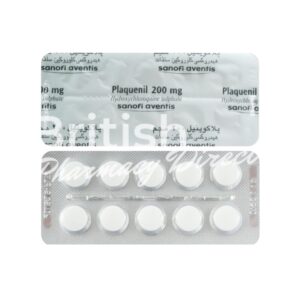
- Form of administration: oral film‑coated tablet (commonly 200 mg scored tablets), taken by mouth with or after food to reduce stomach upset.
- Onset time: varies — malaria prophylaxis protection begins after 1–2 weeks; antiparasitic/parasitological effects can begin within 24–48 hours in treatment; symptomatic benefit for autoimmune conditions often takes 1–2 months.
- Duration of action: long tissue half‑life (drug persists for weeks); malaria prophylaxis should continue for 4 weeks after exposure; autoimmune therapy is often continued for months to years while effective and tolerated.
- Alcohol warning: avoid excessive alcohol — there is no major acute interaction, but alcohol may worsen liver toxicity and gastrointestinal or neurological side effects, so drink with caution.
- The most common side effect is nausea and other gastrointestinal upset (also headaches, dizziness and skin rashes; long‑term use carries a risk of retinal toxicity so regular eye checks are recommended).
- Would you like to try Plaquenil without a prescription?
Basic Plaquenil information
- INN (international nonproprietary name): Hydroxychloroquine.
- Brand names available in the United Kingdom: Plaquenil, Quinoric and generic hydroxychloroquine sulfate.
- ATC code: P01BA02.
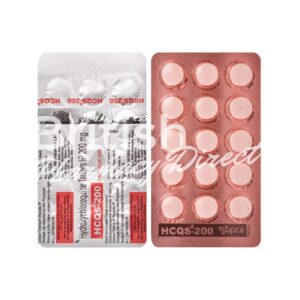
- Forms and dosages: Film-coated tablets 200 mg.
- Registration status in the United Kingdom: Prescription-only medicine (POM) authorised and regulated by the MHRA.
- OTC / Rx classification: Prescription (Rx) only.
Critical warnings and restrictions
High‑risk groups
Who is most at risk when prescribed hydroxychloroquine?
People with pre-existing retinal disease must be identified before treatment starts.
Patients with known cardiac conduction disorders or a history of ventricular arrhythmia require extra caution.
Severe liver or kidney impairment increases the need for dose adjustment and monitoring.
Those with G6PD deficiency should be assessed for haemolysis risk before treatment begins.
Pregnant or breastfeeding people should only use hydroxychloroquine if a specialist advises it.
Children under six should avoid full-strength 200 mg tablets due to overdose risk.
Elderly patients need close monitoring for cumulative retinal damage and potential cardiac issues.
Follow MHRA and NHS guidance on baseline checks and monitoring schedules.
Interaction with activities
Can hydroxychloroquine affect driving or workplace safety?
Hydroxychloroquine may cause dizziness or blurred vision, which can impair driving and use of machinery.
If your role is safety-critical, follow employer policies and inform occupational health if side effects occur.
Avoid tasks that need full alertness until you know how the medicine affects you.
Report new symptoms such as visual disturbance or palpitations promptly to your prescriber or pharmacist.
Q&A — “Can I drive after taking it in the UK?”
Short answer: Usually yes, but only if you feel alert and your vision is normal.
If you experience dizziness, blurred vision or drowsiness, do not drive or operate heavy machinery and contact your prescriber or pharmacist.
Follow employer safety policy if your job involves safety‑critical duties.
Safety checklist for pre‑treatment screening
- Confirm known allergy to hydroxychloroquine or other 4‑aminoquinolines.
- Arrange baseline ophthalmology review before long‑term therapy.
- Perform an ECG if there are cardiac risk factors or the patient uses QT‑prolonging medicines.
- Review liver and renal function and consider dose adjustment if impaired.
- Obtain a full medication list to identify interacting drugs such as azithromycin and certain antipsychotics.
Patient safety checklist to give on dispensing
Provide a written handout stating the indication, dose and duration of therapy.
Advise on common side effects and the need to report visual changes immediately.
Remind patients not to start or stop other medications without consulting a clinician due to QT risk.
Explain Yellow Card reporting and encourage reporting of suspected adverse reactions.
Usage basics
INN, brand names available in the UK
The International Nonproprietary Name is hydroxychloroquine.
Plaquenil is the best-known brand and is commonly dispensed in the UK as 200 mg film‑coated tablets.
Generics labelled hydroxychloroquine sulfate appear routinely in UK pharmacies.
Legal classification
Hydroxychloroquine is a prescription‑only medicine (POM) in the United Kingdom.
It may only be supplied against an authorised prescription from an NHS or private prescriber.
Quick reference
- Brand names: Plaquenil; generic hydroxychloroquine sulfate.
- Formulations: 200 mg film‑coated tablets (most common).
- Legal status: Prescription‑only medicine (POM).
Dosing guide
Standard regimens (NHS guidelines)
What dose will my prescriber usually recommend?
For autoimmune conditions such as rheumatoid arthritis and systemic lupus erythematosus the usual adult dose is 200–400 mg once daily, given as a single dose or divided dose according to clinician preference.
Many clinicians aim to keep dosing at or below 5 mg/kg actual body weight to reduce retinal risk.
Malaria use is outside the UK licence; where used for malaria prophylaxis, the common adult dose is 400 mg once weekly starting 1–2 weeks before travel and continuing for 4 weeks after return.
Malaria treatment regimens use higher initial doses, for example an 800 mg loading dose then 400 mg at specified intervals, with weight adjustments per specialist guidance.
Adjustments for comorbidities
Reduce dose or increase monitoring in severe liver or kidney impairment.
Elderly patients need closer follow up for retinal and cardiac issues.
Paediatric dosing is weight‑based, typically 3–7 mg/kg/day up to 400 mg daily depending on age and indication.
Consider ECG monitoring if concurrent QT‑prolonging drugs are used or if cardiac disease is present.
What if I miss a dose?
Take the missed dose as soon as you remember.
If it is close to the next scheduled dose, skip the missed dose and do not double up.
Contact your GP or pharmacist for regimen‑specific advice if you are uncertain.
Indication/dose/duration summary
| Indication | Typical adult dose | Duration |
|---|---|---|
| Rheumatoid arthritis / SLE | 200–400 mg daily | Often long‑term with monitoring |
| Malaria prophylaxis | 400 mg once weekly | Start 1–2 weeks before travel; continue 4 weeks after |
| Malaria treatment | Loading then divided doses adjusted by weight | Regimen over 3 days per specialist guidance |
Who needs eye or cardiac review before starting?
- Anyone starting long‑term therapy should have baseline ophthalmology assessment.
- Patients with cardiac disease or on QT‑prolonging drugs need ECG prior to and during treatment.
- Those with liver or renal impairment require baseline blood tests and closer follow up.
Interaction chart
Food and drinks
Hydroxychloroquine has few direct food interactions.
Alcohol can worsen gastrointestinal side effects and may increase liver strain with long‑term use.
Avoid grapefruit as a precaution where altered metabolism could affect blood levels.
Taking the tablet with food can reduce stomach upset for sensitive patients.
Common drug conflicts
Which medicines cause concern when taken with hydroxychloroquine?
Combining hydroxychloroquine with QT‑prolonging drugs such as azithromycin and certain antipsychotics increases the risk of cardiac arrhythmia.
Concurrent use with other 4‑aminoquinolines like chloroquine is contraindicated.
Caution is advised with drugs that affect hepatic metabolism or lower the seizure threshold.
Cardiac and visual adverse events are the main safety concerns; report new concerns promptly via the Yellow Card scheme.
| Drug | Interaction | Risk/action |
|---|---|---|
| Azithromycin | Both prolong QT interval | Avoid combination; arrange ECG and specialist review if needed |
| Certain antipsychotics | QT prolongation risk | Assess cardiac history and ECG; consider alternatives |
| Chloroquine | Pharmacologic duplication | Contraindicated; do not co‑prescribe |
| Drugs affecting hepatic metabolism | Possible altered blood levels | Monitor clinically and consider dose adjustment |
Dietary advice
- Limit alcohol intake to avoid worsening GI symptoms and liver strain.
- Take with food if nausea occurs.
- Avoid grapefruit as a precautionary measure.
Legal status and availability in the UK
In our online pharmacy, Plaquenil is available without a prescription, with discreet delivery to the United Kingdom in 9–21 days.
Mechanism and pharmacology
Simplified explanation
How does hydroxychloroquine work for autoimmune disease?
Hydroxychloroquine modulates immune cell activity by altering lysosomal pH and reducing antigen presentation.
This leads to reduced inflammatory cytokine release and decreased immune activation in conditions such as SLE and RA.
The drug also has antiprotozoal properties that historically made it useful for malaria prevention and treatment.
Clinical terms
- Class: Aminoquinoline (ATC P01BA02).
- Retinal accumulation: Drug accumulates in melanin‑containing tissues, including the retina, increasing ocular risk over time.
- Pharmacokinetics: Good oral absorption with a long half‑life and tissue accumulation leading to delayed steady‑state.
PK/PD implications for monitoring
- Long half‑life means toxicity risk increases with prolonged use and higher cumulative dose.
- Steady‑state may take several weeks, which aligns with the delayed therapeutic onset in autoimmune disease.
- Monitoring requirements include baseline and periodic ophthalmology review and clinical assessment for cardiac symptoms.
Indications and off‑label uses
MHRA‑approved uses
- Disease‑modifying therapy for rheumatoid arthritis.
- Treatment for systemic and cutaneous lupus erythematosus.
- Dermatological conditions caused or aggravated by sunlight.
Off‑label practices in NHS and private care
Specialists sometimes use hydroxychloroquine off‑label for other rheumatological or dermatological conditions based on clinical judgement; malaria prevention and treatment are not UK-licensed uses of hydroxychloroquine.
Hydroxychloroquine is NOT recommended for COVID‑19 outside clinical trials due to lack of proven benefit.
When used off‑label prescribers should document rationale and counsel patients about evidence, monitoring and risks.
| Indication | Typical dose | Monitoring needs |
|---|---|---|
| Rheumatoid arthritis | 200–400 mg daily | Baseline eye exam; routine clinical review |
| Systemic lupus erythematosus | 200–400 mg daily | Baseline and annual ophthalmology review |
| Malaria prophylaxis (off-label in the UK) | 400 mg once weekly | Pre‑travel advice and adherence monitoring |
Alternatives matrix
NHS prescribing alternatives
| Agent | Typical use | Monitoring | Main risks |
|---|---|---|---|
| Methotrexate | DMARD for RA and other inflammatory conditions | Regular blood tests and liver monitoring | Hepatotoxicity, teratogenicity |
| Sulfasalazine | DMARD often used in combination therapy | Periodic blood counts and liver tests | Allergic reactions, gastrointestinal upset |
| Leflunomide | DMARD for moderate to severe RA | Baseline liver tests and ongoing monitoring | Hepatotoxicity, teratogenicity |
| Biologic DMARDs | Moderate to severe disease unresponsive to conventional DMARDs | Screening for infections and regular clinical review | Infection risk, variable administration routes |
| Artemisinin derivatives | Malaria treatment in resistant regions | Guided by specialist malaria protocols | Region‑specific resistance and adverse effects |
Pros and cons checklist for shared decision‑making
- Efficacy: Hydroxychloroquine is effective in SLE and mild RA and is often pregnancy‑compatible where alternatives are not.
- Monitoring burden: Alternatives may require more intensive blood testing versus eye monitoring for hydroxychloroquine.
- Pregnancy: Hydroxychloroquine is often maintained in pregnancy for SLE under specialist advice, unlike some DMARDs.
- Route: Alternatives have different administration profiles that affect patient preference.
Common questions
- Will it damage my eyes?
Long‑term use at high cumulative doses increases the risk of retinal toxicity.
Baseline ophthalmology review and periodic screening reduce the risk of missing early changes.
- Is it safe in pregnancy?
Specialist advice is required and many obstetric/rheumatology teams continue hydroxychloroquine in SLE when benefits outweigh risks.
- Can I drink alcohol?
Moderate alcohol is not strictly contraindicated, but excess alcohol can worsen GI side effects and add liver strain with long‑term therapy.
- How quickly will it work?
Therapeutic effects for autoimmune conditions typically appear over weeks to months rather than days.
Escalate to GP or rheumatologist for new visual symptoms, palpitations, severe skin reactions or signs of haemolysis.
Registration and regulation
MHRA approval process
Plaquenil and authorised generics hold UK marketing authorisations and are regulated by the MHRA.
Products are subject to pharmacovigilance and safety communications and adverse events should be reported via the Yellow Card scheme.
NHS prescribing framework
Hospital specialists commonly initiate DMARD treatment and communicate monitoring plans to GPs for shared care.
Prescribing follows local formularies and commissioning guidance and any MHRA safety notices must be implemented promptly.
Regulatory compliance checklist
- Confirm brand and origin against marketing authorisation where required.
- Record batch numbers and expiry for traceability when dispensing.
- Encourage Yellow Card reporting for suspected adverse reactions and follow MHRA guidance.
Storage and handling
UK household storage (cold/damp climate)
Store hydroxychloroquine at room temperature between 15–30°C and protect from moisture and light.
In damp UK homes advise storing medicines away from bathrooms and windows in a dry, temperature‑stable cupboard.
Do not freeze tablets and keep them in original packaging to preserve batch and expiry information.
Guidance from NHS and pharmacists
Keep all medicines out of reach and sight of children as accidental overdose may be fatal.
When travelling carry medication in original containers with a printed list of medicines and indication for customs or medical review.
Dispose of unused tablets by returning them to a pharmacy for safe disposal rather than household waste.
Household storage tips
- Store in a sealed container in a dry room away from heat sources.
- Keep a record of batch number and expiry for reporting if needed.
- Advise patients to show original packaging to clinicians when seeking advice overseas.
Guidelines for proper use
UK pharmacist counselling style
Confirm the indication, exact dose and intended duration with the patient at dispensing.
Review the full medication and over‑the‑counter list to check for QT‑prolonging or interacting medicines.
Ensure a baseline ophthalmology referral is documented for long‑term use and advise on the need for regular reviews.
Discuss common side effects such as GI upset and rash and emphasise urgent reporting of visual changes or palpitations.
Explain the missed dose policy and the urgent actions required in case of suspected overdose.
NHS patient safety advice
Document the monitoring plan in shared records and provide written information to the patient.
Encourage adherence and arrange follow up for effectiveness and safety checks according to local protocols.
Patient handout template
- Reason for treatment and expected time to benefit (weeks to months for autoimmune disease).
- How to take the medicine and what to do if a dose is missed.
- Side effects to expect and signs that need urgent attention.
- Contact details for pharmacist or GP for questions and Yellow Card reporting information.
Pharmacist counselling checklist
- Confirm identity and prescription details and check for allergies.
- Review interacting medications and arrange ECG if required.
- Provide baseline ophthalmology referral information where indicated.
- Advise on safe storage and disposal and provide follow‑up instructions.
Delivery across the United Kingdom
| City | Region | Delivery Time |
|---|---|---|
| London | England | 9–21 days |
| Birmingham | England | 9–21 days |
| Manchester | England | 9–21 days |
| Glasgow | Scotland | 9–21 days |
| Leeds | England | 9–21 days |
| Liverpool | England | 9–21 days |
| Newcastle Upon Tyne | England | 9–21 days |
| Sheffield | England | 9–21 days |
| Bristol | England | 9–21 days |
| Cardiff | Wales | 9–21 days |
| Belfast | Northern Ireland | 9–21 days |
| Edinburgh | Scotland | 9–21 days |
| Norwich | England | 9–21 days |