Inspra
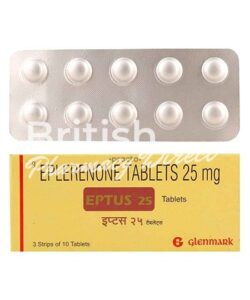
In stock
25mg · 50mg
from 75,68 £
In brief
- Inspra contains eplerenone, an aldosterone blocker added to standard treatment when heart failure involves a poorly pumping left ventricle.
- Both 25 mg and 50 mg tablets are listed, in quantities from 30 to 180.
- A prescription-only medicine in the UK, licensed both as Inspra and as generic eplerenone; this listing is supplied from imported stock.
Inspra: blocking aldosterone in a failing heart
Inspra works through eplerenone, which occupies the mineralocorticoid receptor and so shields it from aldosterone. Left unchecked, aldosterone makes the body hold on to salt and water and, over time, encourages scarring and stiffening of heart muscle. By damping this down, eplerenone lowers the chance of dying from or being admitted to hospital with a cardiovascular cause. The UK SmPC gives it two roles, always on top of existing therapy: for stable patients who have had a recent heart attack and now show signs of heart failure with an ejection fraction of 40% or less, and for adults with NYHA class II chronic heart failure whose ejection fraction is 30% or below.
What is available here
There are two strengths on this page, 25 mg and 50 mg, each offered as 30, 60, 90, 120 or 180 tablets. In the UK eplerenone is a POM, sold under the Inspra brand and as generic tablets of the same strengths from other licence holders. The packs supplied through this page are imported stock rather than UK-licensed packs. Either strength is taken as a single dose once a day, and moving from one to the other should only happen on the prescriber’s instruction, since each change is tied to potassium results.
Starting low and moving to 50 mg
Whichever indication applies, treatment begins with 25 mg once a day, and the aim is to reach 50 mg once daily, preferably within about four weeks, depending on blood potassium. That 50 mg dose is the maximum. After a heart attack, eplerenone is usually introduced between three and fourteen days after the event. It can be taken with food or on an empty stomach. Moderate kidney impairment calls for a gentler start of 25 mg on alternate days. When a moderate CYP3A4 inhibitor such as amiodarone, diltiazem or verapamil is also prescribed, the dose stays at 25 mg daily. Safety in children and adolescents has not been established.
Potassium checks that steer the dose
The main risk with Inspra is too much potassium in the blood. A level is taken before the first tablet, again during the first week and a month into treatment, and after every dose change, then periodically. If potassium reaches 5.5 to 5.9 mmol/L the dose is cut back, and at 6.0 or above the tablets are stopped until it falls below 5.0, when 25 mg every other day may be restarted. Older people, those with reduced kidney function and patients with diabetes or mild-to-moderate liver impairment tend to need closer watching.
Who cannot take eplerenone, and risky combinations
Eplerenone must not be started if potassium is above 5.0 mmol/L, if eGFR is under 30, or in severe liver failure (Child-Pugh C). It is also ruled out with potassium-sparing diuretics or potassium supplements, with strong CYP3A4 inhibitors such as itraconazole, ketoconazole, clarithromycin or ritonavir, and alongside an ACE inhibitor and an angiotensin receptor blocker taken together. Lithium, ciclosporin, tacrolimus, trimethoprim and anti-inflammatory painkillers need care, and enzyme inducers such as rifampicin, carbamazepine or St John’s wort can make it less effective.
Side effects reported with Inspra
In the large clinical trials, adverse events overall occurred about as often as with placebo. Among the common ones are high potassium, insomnia, headache, light-headedness or blackouts, a drop in blood pressure, coughing, an upset stomach or bowels, itchy skin or a rash, cramp and backache, along with rises in creatinine and urea. Gynaecomastia, low sodium and angioedema are uncommon. Any decision to start eplerenone, and at which strength, rests with the prescriber.