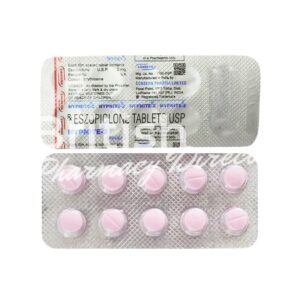
Hypnite
In brief
- Hypnite (eszopiclone) is a prescription-only medicine and is not licensed in the UK.
- Hypnite is used for the short-term treatment of insomnia. Its active ingredient, eszopiclone, is a non-benzodiazepine hypnotic that works by enhancing the effect of GABA in the brain, helping to induce sleep and reduce night-time awakenings.
- The usual dose for adults is 2–3 mg at bedtime, with a maximum of 3 mg per night. In elderly patients, the usual starting dose is 1 mg at bedtime, with cautious titration if needed.
- The form of administration is an oral tablet.
- It usually starts to work within about 30 minutes after taking it at bedtime.
- The duration of action is generally around 6–8 hours, which is why it should be taken only when you can allow a full night’s sleep.
- Do not take Hypnite with alcohol, as alcohol can greatly increase drowsiness, impair coordination, and raise the risk of dangerous side effects.
- The most common side effects are metallic taste, dry mouth, headache, dizziness, somnolence, and next-day drowsiness.
- Would you like to try Hypnite without a prescription?
Critical warnings, safety, and patient protection
Thinking about Hypnite because sleep has become a nightly struggle?
That is understandable, but this medicine needs proper caution.
Hypnite is eszopiclone, a prescription-only sleeping tablet that is not licensed in the UK; it should only be used if prescribed and reviewed by a qualified clinician.
It is not suitable for everyone, especially if there is a history of sleepwalking or sleep-driving, severe liver problems, breathing difficulties, severe sleep apnoea, depression, substance misuse, or suicidal thoughts.
Alcohol and other central nervous system depressants can increase sedation and next-day impairment, so they should be avoided.
Use for chronic insomnia without review is not recommended, because prolonged use increases the risk of tolerance and dependence.
For UK patients, there is also a practical safety issue: next-day drowsiness can affect driving, cycling in traffic, operating machinery, and safety-critical work.
If a patient feels even slightly unsafe the next morning, they should not drive under UK law.
- Stop and seek help if sleepwalking, sleep-eating, sleep-driving, confusion, a fall, breathing problems, or unusual behaviour occurs.
- Stop and seek help if there is severe daytime sedation, memory loss, or signs of misuse or dependence.
- Do not take with alcohol, opioids, benzodiazepines, or other sedatives unless a prescriber specifically says so.
High-risk groups
Older adults are more sensitive, so clinicians usually start low and monitor closely.
Pregnancy and breastfeeding need a careful risk-benefit decision and are only for situations where use is clearly necessary.
Children should not be given Hypnite because safety and efficacy have not been established.
Micro-FAQ
Q: Can Hypnite cause complex sleep behaviours? A: Yes, and that includes sleepwalking, eating, or driving while not fully awake, which needs urgent medical review.
Basic Hypnite information
- INN (international nonproprietary name): Eszopiclone
- Brand names available in the United Kingdom: Hypnite is not licensed in the UK
- ATC code: N05CF04
- Forms and dosages: Tablets, 1 mg, 2 mg, 3 mg
- Registration status in the United Kingdom: not licensed in the UK
- OTC / Rx classification: Prescription-only (Rx)
Packaging is typically in blister strips of 10, 14, or 30 tablets.
In UK practice, Hypnite is closer to zopiclone (Zimovane), zolpidem (Stilnoct), and temazepam than to an over-the-counter sleep aid.
How Hypnite works in the body
People often ask what makes one sleeping tablet different from another.
Eszopiclone works on the brain’s sleep pathways as a non-benzodiazepine hypnotic, helping to make sleep easier to start and, for some people, easier to maintain.
It is designed for insomnia relief, not for fixing the underlying cause of poor sleep.
That means it can help on a difficult night, but it is still important to look at stress, pain, caffeine, shift patterns, anxiety, or other causes if sleep problems keep coming back.
The ATC code is N05CF04, which fits into the following structure:
- N — Nervous system
- N05 — Psycholeptics
- N05C — Hypnotics and sedatives
- N05CF — Non-benzodiazepine hypnotics
A simple way to think about it is this: Hypnite is a sedative-hypnotic medicine that supports sleep onset, but it does not cure insomnia.
Micro-FAQ
Q: Is Hypnite the same as zopiclone? A: No, they are related Z-drugs, but Hypnite’s INN is eszopiclone, not zopiclone.
Who Hypnite may be used for
Most patients asking about Hypnite are usually not after a long-term solution.
They want a short-term insomnia treatment because poor sleep is affecting work, mood, or family life.
That is the context in which a clinician may consider a sleeping pill after a proper assessment.
Sleep hygiene and possible triggers should be discussed first, because not every sleepless night needs medication.
Clinicians may consider it when there is:
- Difficulty falling asleep.
- Short-term insomnia with a clear daytime impact.
- A situation where a hypnotic is judged appropriate after assessment.
It is not routinely used for shift-work sleep disorder unless specifically advised by a clinician.
It is also not a general answer to repeated insomnia without reassessment.
Micro-FAQ
Q: Is Hypnite used for shift-work sleep disorder? A: Not routinely, and it should only be used for that if a clinician specifically advises it.
Dosage basics for UK readers
The usual dose depends on age and liver function, and it should be taken only at bedtime.
For adults, the usual dose is 2 to 3 mg at bedtime, with a maximum of 3 mg per day.
For elderly patients, the usual starting dose is 1 mg at bedtime, with cautious increases only if needed and usually with a lower ceiling.
In hepatic impairment, the dose should not exceed 2 mg per night.
Children should not receive it because safety and efficacy have not been established.
The short-term treatment window is generally 2 to 4 weeks.
| Condition / group | Usual dose | Key note |
|---|---|---|
| Adult insomnia | 2 to 3 mg at bedtime | Maximum 3 mg/day |
| Elderly | 1 mg at bedtime | Start low and monitor closely |
| Hepatic impairment | Do not exceed 2 mg per night | Higher risk of excess sedation |
| Renal impairment | Use the lowest effective dose | No significant adjustment usually needed |
| Children | Not recommended | Safety and efficacy not established |
Before taking tonight’s dose: make sure there is time for a full night’s sleep, no alcohol has been taken, and no other sedatives are being used.
Micro-FAQ
Q: What if I miss a dose? A: Skip it, and do not double up or take it outside bedtime.
How to take Hypnite safely
A common mistake is taking a sleeping tablet and then staying up for another hour.
That increases the chance of next-morning impairment.
Swallow the tablet with water only when you can allow a full night in bed.
No standard liquid or injectable form is used in community or hospital settings.
Do not mix it with alcohol, and do not re-dose in the same night.
It should also not be shared with family members, even if they say they have “the same problem”.
- Do take it only at bedtime.
- Do allow enough time to sleep.
- Do not drive, cycle in traffic, or use machinery if sleepy.
- Do not take more than prescribed.
Side effects, next-day impairment, and when to get help
Most patients want to know about the common problems first.
With Hypnite, these can include metallic taste, dry mouth, headache, somnolence, and dizziness.
Some people also notice impaired coordination, memory disturbance, and next-day drowsiness.
Parasomnias can happen too, including sleepwalking or other behaviours during which the person is not fully awake.
Tolerance and dependence risk increases with prolonged use, which is another reason it is not meant to be a long-term fix.
| Type | Examples | Action |
|---|---|---|
| Common | Metallic taste, dry mouth, headache, somnolence, dizziness | Discuss if persistent |
| Less common | Impaired coordination, memory disturbance, next-day drowsiness | Review with a pharmacist or prescriber |
| Urgent | Sleepwalking, sleep-driving, confusion, falls, breathing problems, unusual behaviour | Stop and seek medical help |
Next-day drowsiness can be more likely in older adults, in people taking other sedatives, or when there has not been enough sleep time.
Micro-FAQ
Q: Is next-day drowsiness common? A: It can happen, especially in older people, with other sedatives, or if there is not enough time for sleep.
Interactions with food, drink, and other medicines
Alcohol is the main thing to avoid.
It can deepen sedation and make complex sleep behaviours more likely.
Caffeine, tea, and coffee do not usually create a direct drug interaction, but they can still make sleep harder, especially in the evening.
Other central nervous system depressants are a concern too, because sedation can add up quickly.
| Category | Examples | Advice |
|---|---|---|
| Avoid | Alcohol, other CNS depressants | Do not combine |
| Use caution | Zopiclone, zolpidem, temazepam, opioids, antihistamines | Ask a pharmacist or prescriber first |
| Ask a pharmacist | Antipsychotics, some antidepressants, other sleep medicines | Check for additive sedation |
If a patient suspects a reaction, they should discuss it with their pharmacist or prescriber and use Yellow Card reporting where appropriate.
Legal status and availability in the UK
In our online pharmacy, Hypnite is available without a prescription, with discreet delivery to the United Kingdom in 9–21 days.
Patients should still treat any sedative medicine with proper caution and medical advice.
Regulation, MHRA oversight, and prescribing framework
Hypnite and other eszopiclone brands are prescription medicines and are not licensed in the UK.
The prescribing framework is straightforward in principle: diagnosis, risk assessment, a clear review plan, and the shortest effective duration.
Long-term use is not routine and should be re-evaluated rather than continued automatically.
The same applies to insomnia medication generally, whether the comparison is zopiclone, zolpidem, or temazepam.
- MHRA — Medicines and Healthcare products Regulatory Agency.
- Rx / POM — Prescription-only medicine.
- Review — Follow-up to check benefit, side effects, and ongoing need.
Who should not take Hypnite, or needs extra caution
Some situations make Hypnite unsuitable from the start.
Other situations mean it can only be considered with careful monitoring.
| Category | Examples | Comment |
|---|---|---|
| Absolute contraindications | Known hypersensitivity, history of complex sleep behaviour, severe hepatic impairment | Do not use |
| Relative contraindications | Respiratory depression, severe sleep apnoea, substance misuse, alcoholism, depression, suicidal ideation | Use only with caution and monitoring |
| Special situations | Pregnancy, breastfeeding | Use only if clearly necessary |
That screening is especially important in people who have had unusual sleep behaviours before.
Micro-FAQ
Q: Is Hypnite safe in pregnancy? A: It should only be used if the clinician believes the benefit clearly outweighs the risk.
Storage, handling, and travel advice
Keeping the tablets properly stored helps preserve their quality.
Store them at 15 to 30°C, away from moisture and direct sunlight.
Keep them in the original blister packaging and do not refrigerate or freeze them.
For travel, the medicine should be kept in hand luggage where appropriate, along with any prescription details or pharmacy paperwork.
That is particularly sensible if travelling on a flight or staying somewhere damp, because UK bathroom storage is not a good idea for most medicines.
- Keep in original packaging.
- Protect from moisture.
- Avoid bathroom storage.
- Use travel documents if moving across borders.
Alternatives to Hypnite in UK practice
Not every patient will suit eszopiclone.
That is why clinicians sometimes compare it with zopiclone, zolpidem, temazepam, and non-drug approaches.
Melatonin MR, such as Circadin, may be considered for selected patients, depending on the clinical situation.
The right choice depends on speed of onset, duration, dependence risk, next-day sedation, and whether the person is older or has other illnesses.
| Option | Main strength | Main limitation |
|---|---|---|
| Hypnite / eszopiclone | Useful for short-term insomnia | Next-day drowsiness and dependence risk |
| Zopiclone | Well known in UK practice | Similar sedative concerns |
| Zolpidem | Can help with sleep onset | Complex sleep behaviours can occur |
| Temazepam | May be used short term | Benzodiazepine dependence risk |
| Melatonin MR | May suit selected patients | Not appropriate for everyone |
- Faster onset can be helpful when sleep is the main issue.
- Next-day sedation matters if there is driving or safety-critical work.
- Dependence risk matters when insomnia has lasted for weeks.
- Older adults often need the most conservative option.
Patient counselling points for proper use
Good pharmacist counselling often makes the difference between a useful short-term treatment and a risky one.
That is why bedtime-only use, short duration, and no alcohol are repeated so often.
Patients should also ask about side effects, interactions, and follow-up rather than waiting until problems build up.
Hypnite is not for chronic insomnia without review, and insomnia should be re-assessed if symptoms continue beyond the short-term window.
- Use only as prescribed or advised by a clinician.
- Stop and seek help for abnormal sleep behaviour, severe drowsiness, breathing problems, or an allergic reaction.
- Do not combine with alcohol or other sedatives.
- Do not use if the next morning feels unsafe for driving or work.
- Reassess ongoing insomnia rather than continuing indefinitely.
Delivery across the United Kingdom
| City | Region | Delivery time |
|---|---|---|
| London | Greater London | 9–21 days |
| Birmingham | West Midlands | 9–21 days |
| Manchester | North West England | 9–21 days |
| Glasgow | Scotland | 9–21 days |
| Edinburgh | Scotland | 9–21 days |
| Liverpool | North West England | 9–21 days |
| Leeds | West Yorkshire | 9–21 days |
| Bristol | South West England | 9–21 days |
| Cardiff | Wales | 9–21 days |
| Newcastle upon Tyne | North East England | 9–21 days |
| Sheffield | South Yorkshire | 9–21 days |
| Nottingham | East Midlands | 9–21 days |
| Coventry | West Midlands | 9–21 days |
| Leicester | East Midlands | 9–21 days |
| Aberdeen | Scotland | 9–21 days |